

Optional Study Materials
Kettlebell Trainer Certification
Kettlebell Trainer Certification
Black Friday Sale - 25% Off Lifetime Certifications
Earn your Kettlebell Trainer Certification and coach strength, conditioning, movement control and progression through effective kettlebell-based programming.
Pay Only If You Pass
ICOES Accredited
100% Online & Self-Paced
No Required Coursework
Instant Digital Certificate
100,000+ Certifications Issued Worldwide
Couldn't load pickup availability
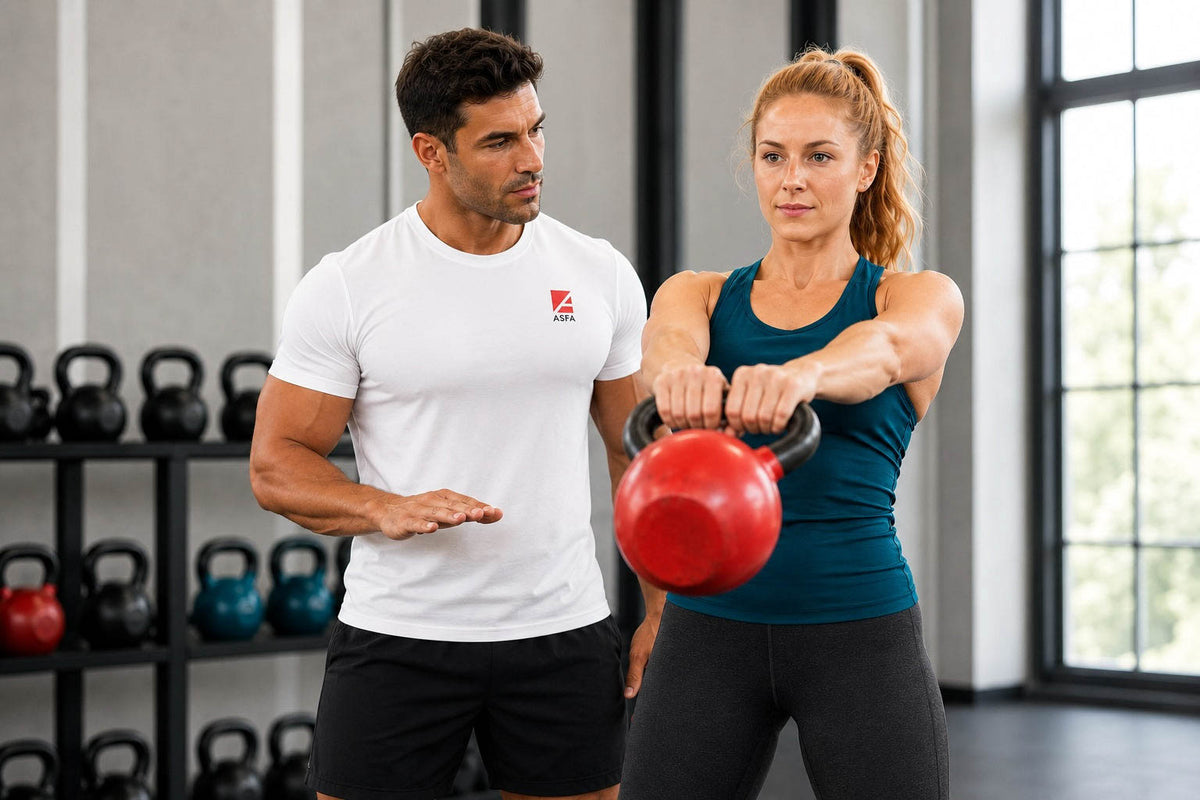
About Our Kettlebell Trainer Certification
The handle sits above the center of mass. The bell can move around the hand, away from the body, overhead, or through a ballistic arc. That design makes the kettlebell versatile, but it also changes how exercises are learned and coached.
ASFA’s Kettlebell Trainer Certification recognizes knowledge of foundational kettlebell technique, exercise progression, programming, coaching cues, and the difference between controlled strength movements and ballistic work. It is relevant to personal trainers, group instructors, strength coaches, and prepared fitness enthusiasts who want to use the tool with more than a random list of swings.
Ballistics and Grinds Need Different Coaching
Presses, squats, rows, and carries are generally controlled strength movements. Swings, cleans, and snatches use momentum and rapid force production. The athlete has less time to make an adjustment once a ballistic repetition begins.
That difference affects progression. A client who has not learned to hinge, brace, and control the kettlebell close to the body should not be rushed into high-repetition ballistic work. A clean should become efficient before it is used to create fatigue. A snatch should not be introduced simply because it looks advanced.
Kettlebell Exercise Selection
Kettlebells are often marketed as a complete system. They can support many goals, but no tool is automatically the best choice for every client. A barbell may be better for maximal loading. A machine may provide more stability. A dumbbell may be easier to learn for a particular movement.
Competent coaches choose the kettlebell when its design improves the session, such as for a swing, carry or front-loaded squat in a compact training space. The tool earns its place by solving a programming problem, not by becoming the theme of every workout.
What the Exam Covers
- Setup and grip: understanding handle position, wrist alignment, stance, and a stable starting position.
- Hinge mechanics: distinguishing a hip-driven swing from a squat-dominant movement.
- Ballistic skills: coaching the swing, clean, and snatch with attention to timing, path, and control.
- Strength movements: applying presses, squats, rows, carries, and get-up progressions appropriately.
- Breathing and bracing: coordinating trunk control with the movement and load.
- Progression: developing patterns and positions before increasing speed, complexity, or volume.
- Programming: using kettlebells for strength, power, conditioning, skill, or mixed goals without confusing the objective.
- Loading: selecting a bell that allows the intended technique and adaptation.
- Group logistics: accounting for spacing, bell placement, transitions, and participant visibility.
- Professional judgment: stopping or modifying when technique deteriorates and referring concerns outside the trainer’s scope.
Who Can Take the Exam?
Personal trainers may use the specialty to broaden strength and conditioning options. Group instructors can improve technique standards in kettlebell classes. Athletes and enthusiasts with substantial practice may want formal recognition before coaching others.
How to Earn Your Certification
Start the online exam whenever you’re ready. You can prepare with your own resources or use optional study materials. If you pass, choose your certification option and complete checkout. Your digital certificate is normally emailed within minutes of checkout.
Certification Options
- Certificate Only (1 Year): $299
- Certificate & Pocket Certification Card (1 Year): $329
- Certificate & Pocket Certification Card (Lifetime): $899
To renew a one-year certification, retake the exam and purchase certification again.
Lifetime certification has no annual renewal payment or retesting. Lifetime certification stays valid if you remain active in your certified field and complete one relevant continuing education class, course or seminar each year. Submit it to ASFA for approval before taking it and provide proof of completion upon request.
Accreditation
ASFA is accredited by the International Council for Online Educational Standards (ICOES).
Employer Requirements
If you’re earning this certification for a specific job, we recommend checking with the employer about their certification requirements.
Frequently Asked Questions
Do I pay before taking the exam?
No. You can take the online exam before paying. If you pass, choose your certification option and complete checkout.
What happens if I don’t pass the exam?
You can review the material and retake the exam at no charge. You pay only if you pass and choose to purchase your certification.
How long is the certification valid?
One year or lifetime, depending on the option you choose after passing. To renew a one-year certification, retake the exam and purchase certification again. Lifetime certification stays valid if you remain active in your certified field and complete one relevant continuing education class, course or seminar each year. Submit it to ASFA for approval before taking it and provide proof of completion upon request.
Is a kettlebell swing a squat?
The common swing is primarily a hip-hinge movement, though styles and individual mechanics vary. The coach should understand the intended pattern and avoid turning every swing into a deep squat.
Related Certifications: Strength & Conditioning Coach · HIIT Instructor · Functional Fitness Trainer · Tactical Fitness Trainer · Calisthenics & Bodyweight Trainer