
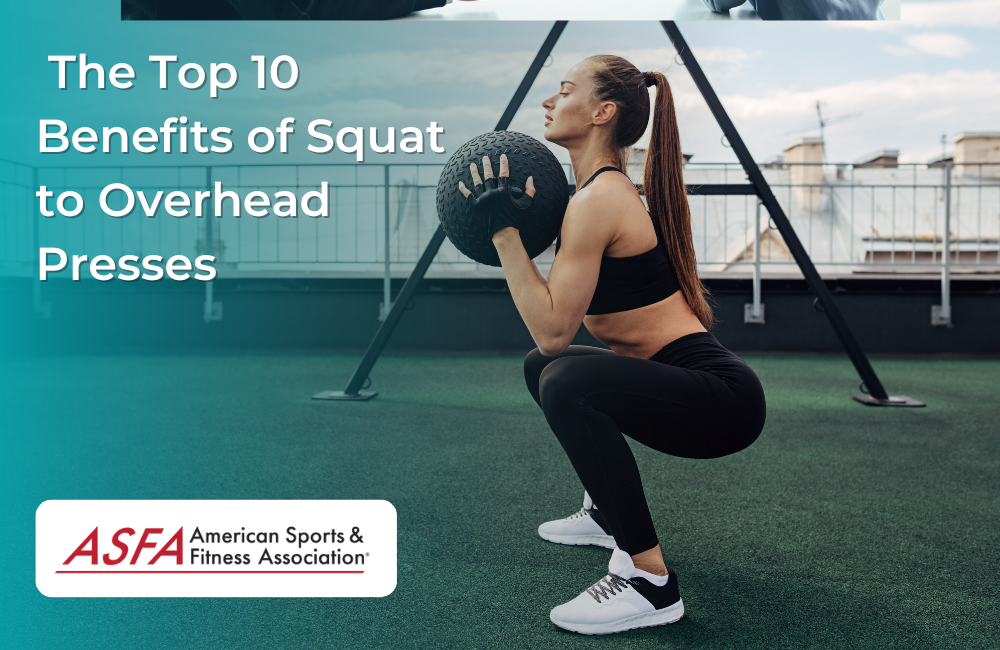
The Top 10 Benefits of Squat to Overhead Presses
The points in The Top 10 Benefits of Squat to Overhead Presses are organized around practical application rather than exaggerated promises.
Technique is not a single perfect shape. It is a repeatable way to complete the movement while controlling the load, range, and positions that matter for the goal. A simple rule helps: keep the goal visible and adjust the method.
Practical Guidance
Practical point: Choose the variation that permits a stable setup and repeatable range. Add repetitions or resistance only while the same control is maintained; stop when pain or compensation changes the movement.
Squat to overhead press is one of the best hybrid exercises.
Squat to overhead press is one of the best hybrid exercises. A hybrid exercise combines two or more different types of exercises, and squat to overhead press is just that: a combination of squats and overhead presses.
It's a great compound exercise.
Squats are a compound movement, meaning that they work multiple muscle groups at the same time. Compound exercises are more effective than isolation exercises because they engage your body's core and all of its major muscle groups.
It's a great full-body workout.
Squat to overhead presses is a great full-body workout. They work your legs, arms, shoulders, and core.
Likewise, when you press upwards with the weights in hand, it requires more strength in your upper body than if those same weights were resting on the floor or bench behind you (as they would be during regular dumbbell shoulder presses).
Squatting also helps improve posture by strengthening the muscles around your pelvis and lower back so they can better support the spine as it curves forward at its center point--a common cause of poor posture is weak gluteal muscles which pull down on this area, often resulting in rounded shoulders and slouched posture; however squatting can help combat this effect by strengthening these muscles through repetitive lifting motions that mimic everyday activities like walking up stairs etcetera!
It improves your upper body strength and power while building leg muscle mass, which is hard to do with traditional bench press variations.
Squat to overhead presses are a great alternative to traditional bench press variations. The squat-to-overhead press targets both your upper body and lower body, allowing you to work on muscle mass in two areas of your body simultaneously.
This exercise is also useful for those who want to improve their power and strength without adding too much bulk or size. If you have a shoulder injury or are worried about injuring your shoulders, this exercise may be right up your alley!
You can do them anywhere.
Squat to overhead presses are a great exercise because you can do them anywhere. You don't need a gym membership, and you don't even need any equipment!
You can also do these exercises at home or work--just grab some lighter weights from the garage or basement (or ask someone who lives with you) if necessary.
You can use different equipment - kettlebells, dumbbells, or barbells - for an incredibly challenging workout.
There are many ways to perform the squat to overhead press, and this exercise can be done with any equipment. If you're just starting, use a barbell or dumbbell and gradually increase the weight as you get stronger.
The beauty of using different types of equipment is that it will keep your workouts interesting--and help ensure that you never plateau!
Squat to overhead presses is a great way to get comfortable squatting, pressing, and moving heavy weights.
Squats are an excellent exercise for building lower body strength. They can be done with your body weight or weighted with dumbbells, kettlebells, or barbells.
Try out this new kind of lift today!
If you're not sure about trying the squat to overhead press, start by doing it in your own space. This can be done with minimal equipment and will give you an idea of how much weight is needed for proper execution.
Squat to overhead press is a great training tool for improving overhead mobility, strength, and conditioning.
The squat-to-overhead press is a great way to improve shoulder mobility, strength, and conditioning.
When you perform the squat to overhead press, your shoulders will be forced into an extended position which can help improve shoulder mobility. As well as this, performing the movement slowly will also help with improving mobility in your thoracic spine (upper back).
Improving shoulder stability is another benefit of this exercise, as it forces you to work harder at maintaining a stable core throughout each repetition which can help help manage injury risk by strengthening key muscles around the lower back area, such as the hamstrings and glutes.
Squat to overhead press improves shoulder health.
The squat-to-overhead press helps you improve your shoulder mobility and strength, which can benefit those who have suffered from injuries or need work on their flexibility.
Squat to overhead press helps build core stability.
Core stability is important for many sports, and it can help you may help manage injury risk as well. When you have a strong core, your body will be better able to handle any exercise you do.
Squat to overhead press engages the glutes and hips.
Squat to overhead press is a great full-body exercise that engages the glutes and hips. If you're looking for an exercise that will help you strengthen these areas, squat to overhead press should be on your list of exercises to try!
This move is also great for beginners because it allows them to build up their core strength without having any balance issues or fear of falling over during the movement.
Squat to overhead presses help you with everyday life activities like lifting heavy objects or shifting from sitting to standing.
Squat to overhead presses is a great training tool for improving overhead mobility, strength, and conditioning. They also improve shoulder health by strengthening the rotator cuff muscles that keep your shoulders stable during overhead movements, such as throwing a ball or swinging an ax at zombies (if you're into that sort of thing).
The Useful Conclusion
The best application is specific enough to guide action and flexible enough to change when the person or circumstances change.


