
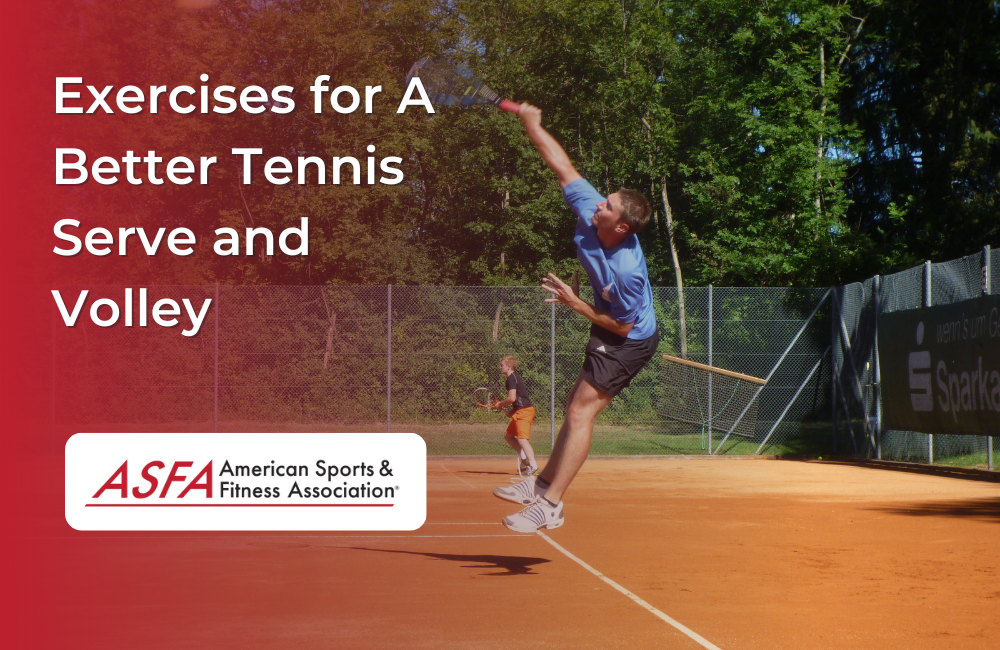
Exercises for a Better Tennis Serve and Volley
A stronger tennis serve and volley depends on timing, force transfer, positioning, and repeated exposure to the skill. Gym exercises can support those qualities, but they do not replace serving practice, footwork, or coaching on the court.
The goal of supplemental training is to build usable leg drive, trunk control, shoulder capacity, and the ability to move forward and stabilize for the first volley.
Train the Movement Demands, Not an Imitation
The serve transfers force from the ground through the legs, trunk, shoulder, arm, and racquet. The volley requires a quick split step, short acceleration, controlled deceleration, and a stable racquet face. Strength training should improve those capacities without trying to recreate the exact stroke with heavy resistance.
Use normal tennis practice for technical work. In the gym, choose movements that can be loaded, repeated, and progressed safely.
Exercises and Coaching Notes
1. Split Squat
Use a staggered stance and lower under control while the front foot stays planted. Drive through the working leg to stand.
Coaching note: Single-leg strength supports force production and control during the approach to the net.
2. Lateral Bound to Stick
Bound sideways from one leg to the other and hold the landing briefly. Begin with a short distance before adding speed.
Coaching note: The ability to stop matters as much as the distance of the jump.
3. Medicine-Ball Scoop Toss
Stand sideways to a wall, load through the hips, and rotate to throw a medicine ball at chest or waist height. Retrieve only after the ball stops moving.
Coaching note: Use a ball and wall designed for throwing and keep the movement explosive rather than exhausting.
4. Half-Kneeling Cable Lift
Kneel with one knee down and move a cable from low beside one hip to high across the body. Resist excessive lower-back extension.
Coaching note: The exercise trains force transfer through the trunk without copying the serve.
5. Single-Arm Landmine Press
Press the end of a landmine forward and upward from one shoulder while the trunk remains controlled.
Coaching note: The angled press can build shoulder and triceps strength through a sport-friendly path.
6. Band External Rotation
Keep the elbow near the side or supported at shoulder height and rotate the forearm against light band resistance.
Coaching note: Use this as controlled shoulder accessory work, not as a maximal strength test.
7. Split-Step Acceleration
Begin in a ready position, perform a small split step, and accelerate two or three steps toward a called direction.
Coaching note: React to a visual or verbal cue once the basic footwork is consistent.
Programming the Movements
Use two or three strength sessions per week depending on the tennis schedule. Keep explosive throws and bounds low in repetition and early in the session. Strength work can use moderate sets and repetitions, while shoulder accessory work usually fits lighter loads and controlled tempo.
Reduce gym volume during tournaments or heavy match weeks. Serving already creates substantial shoulder and trunk demand; the weekly plan should combine court and gym stress instead of treating them as separate worlds.
Common Mistakes to Avoid
- Using heavy resisted serves: Build strength with trainable gym movements and develop technique with the racquet.
- Ignoring deceleration: Include landing, stopping, and change-of-direction work.
- Training the shoulder only: The serve starts from the ground and depends on the legs and trunk.
- Adding fatigue before skill practice: Perform important serving and volley drills while coordination is still high.
Practical Takeaway
Leg strength, rotational power, shoulder capacity, and first-step movement can support a better serve-and-volley game. Keep the gym work complementary and let on-court practice teach the actual strokes.
Integrating Gym and Court Sessions
Place high-quality serving practice and explosive throws before exhausting conditioning. Heavy lower-body lifting can be separated from the most demanding court day or reduced when matches accumulate. The athlete should arrive at important skill sessions able to coordinate the stroke.
A simple week might use two strength sessions, two technical tennis sessions, one match or high-intensity point session, and lower-intensity aerobic work. The exact schedule should follow the competitive calendar and recovery response.
Return-to-Serve Progression
After time away, rebuild serve volume gradually. Count total serves as well as session duration, and monitor how the shoulder and trunk respond the next day. Pain or a sudden loss of control requires assessment rather than extra resistance exercises.


