

Recommended Texts & Manuals
Balance & Stability Instructor Certification
Balance & Stability Instructor Certification
Earn your Balance & Stability Instructor Certification and help clients improve coordination, control, movement confidence and functional stability.
Pay Only If You Pass
Fully Accredited
100% Online & Self-Paced
No Required Coursework
Instant Digital Certificate
100,000+ Certifications Issued Worldwide
Couldn't load pickup availability
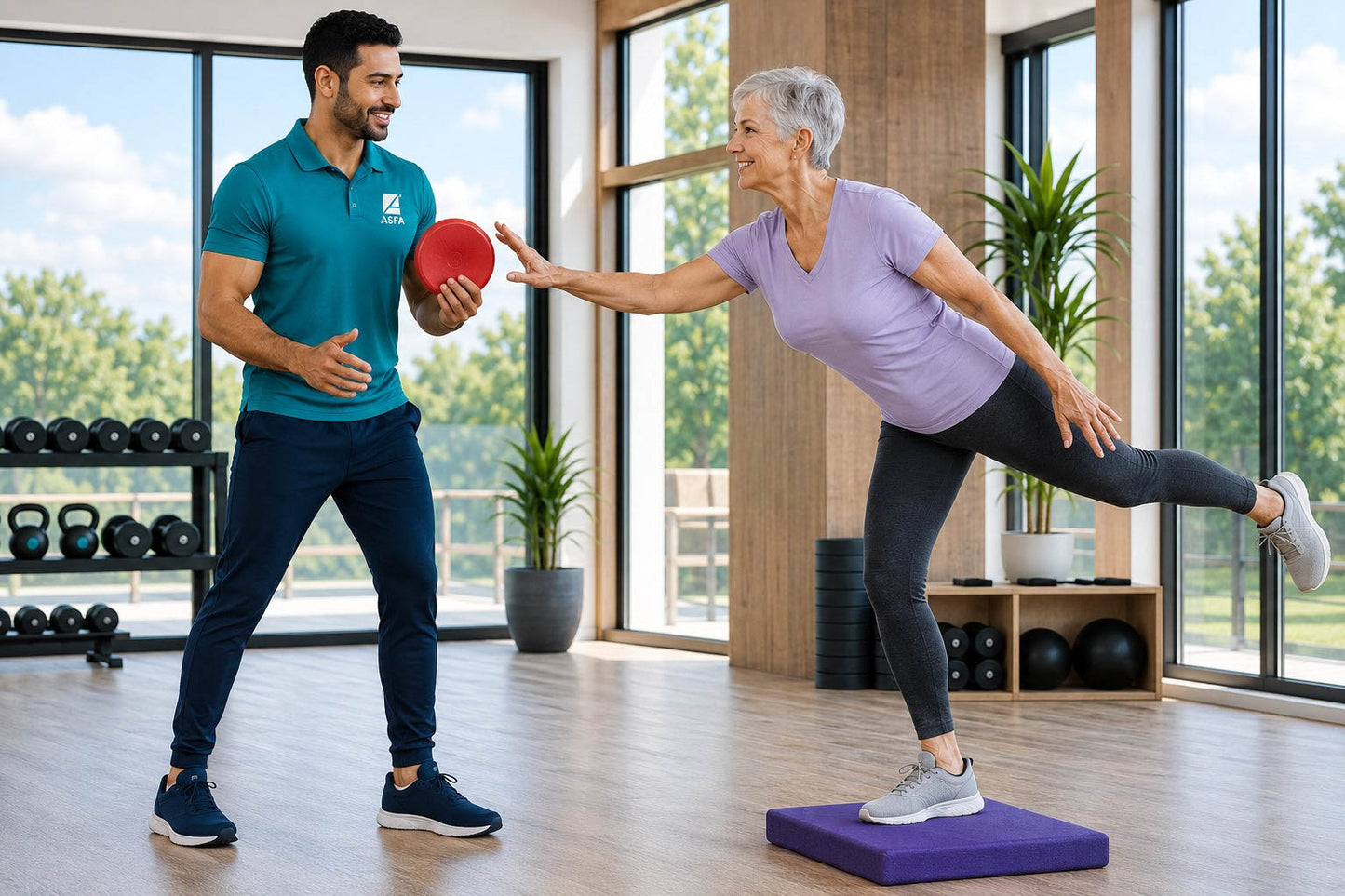
About Our Balance & Stability Instructor Certification
Balance Is a Skill, Not a Single Exercise
Standing on one foot can be useful, but it is not a complete balance program. Stable movement depends on strength, posture, sensory information, reaction, coordination, confidence, and the ability to control the body's position while the task or environment changes.
ASFA's Balance & Stability Instructor Certification gives prepared candidates a direct way to demonstrate knowledge of postural control, base of support, movement progression, coordination, mobility, exercise selection, and professional scope. That knowledge may come from personal training, senior fitness, athletics, group exercise, academic study, or years of focused independent learning.
You can take the online examination before paying for the credential. Pass first, then decide whether to purchase the certification. If you do not pass, you are not charged. Review the concepts that need work and return when you are better prepared.
What Is a Balance & Stability Instructor Certification?
A Balance & Stability Instructor Certification is a specialty fitness credential that recognizes knowledge of exercises and programming used to support postural control, coordination, movement confidence, and stability. It addresses static and dynamic balance, strength, mobility, stance, support, progression, cueing, and safe instruction within fitness scope.
The purpose is not to promise that one class will prevent every fall or injury. Balance is influenced by many factors, some of which are outside a fitness instructor's role. The credential focuses on what the instructor can control: selecting appropriate tasks, progressing them logically, observing movement, and respecting professional boundaries.
From Stillness to Real-Life Movement
Static balance is only the beginning. Daily movement involves stepping, turning, reaching, changing direction, moving between levels, and responding when the environment is not perfectly predictable. Athletic movement adds acceleration, deceleration, speed, and external load. Older adults may prioritize confidence during transitions and everyday tasks.
A useful program moves from stable and understandable toward more demanding only when the participant is ready. Progression may involve narrowing the base of support, changing the surface, moving the head or arms, adding direction changes, reducing hand support, introducing a second task, or increasing movement speed. More difficulty is not automatically more effective.
The instructor should know what quality is being challenged and why. Random instability can make an exercise look advanced while reducing the participant's ability to produce useful force or practice the intended movement.
What You Will Be Expected to Understand
- Base of support and center of mass: recognizing how stance, body position, and movement direction change stability demands.
- Static and dynamic balance: progressing from controlled positions to purposeful movement rather than treating all balance tasks as interchangeable.
- Strength and postural control: understanding how the feet, legs, hips, trunk, and upper body contribute to stable movement.
- Mobility: considering whether available range affects the participant's strategy and exercise choice.
- Coordination and reaction: selecting tasks that develop timing and response without creating unnecessary confusion.
- Progression and regression: changing support, stance, range, speed, direction, visual demand, or complexity one variable at a time when appropriate.
- Cueing and environment: arranging space, equipment, and instructions so the participant understands the task and can practice with confidence.
- Population-specific application: adjusting the program for older adults, general fitness clients, athletes, beginners, and other appropriate audiences.
- Professional scope: separating fitness instruction from diagnosis, treatment, vestibular care, rehabilitation, and other clinical services.
Balance training is strongest when it has a reason. The task should connect to the participant's goals rather than exist because the equipment looks challenging.
Confidence Matters, but It Cannot Be Forced
Participants who feel uncertain about balance may become guarded, rush through a task, or avoid movement altogether. The instructor can help by choosing an appropriate starting point, explaining the purpose, providing support options, and allowing enough successful practice before adding difficulty.
Confidence grows from evidence. A participant completes the task, understands the cue, and recognizes improvement. The instructor should create opportunities for that evidence without promising outcomes that no certification can guarantee.
Who May Be Ready for This Credential?
The certification can fit personal trainers, senior-fitness instructors, group instructors, coaches, recreation professionals, and knowledgeable fitness enthusiasts. Some candidates use balance training primarily with older adults. Others apply it to athletic movement, functional fitness, or general coordination.
You do not have to hold a professional title before testing. ASFA evaluates knowledge. If you have studied the subject and understand how to apply it responsibly, you may be prepared. If not, you can use the exam as a review without being charged for an unsuccessful attempt.
How Specialization Can Support Your Services
Balance and stability are relevant across many fitness settings, but a specialty credential can make that knowledge more visible. It may support active-aging classes, functional training, small-group instruction, movement-focused sessions, or complementary programming within a broader personal-training practice.
No credential guarantees clients or higher income. Clear specialization can still improve marketability by helping people understand the service you offer. Balance-focused professionals often add Senior Fitness, Tai Chi, Functional Fitness, or Core Fitness.
Take the Examination Before You Purchase
ASFA's process allows you to test your current knowledge first. There are no required courses or scheduled testing dates. Optional study resources are available for candidates who want to prepare.
After you pass, complete checkout only if the certification is worthwhile to you; your digital certificate is normally emailed within minutes. If you do not pass, you are not charged. Study the areas that need attention and return when you are ready.
ASFA is fully accredited by the International Council for Online Educational Standards (ICOES).
Frequently Asked Questions
Is balance training only for older adults?
No. Older adults are an important audience, but balance and stability also matter in general fitness, athletics, movement skill, and functional training. The program should reflect the participant and the goal.
Does this certification qualify me to provide rehabilitation?
No. It is a fitness credential, not a rehabilitation or clinical license. Instructors should remain within their scope and refer concerns that require diagnosis or treatment.
Can a fitness enthusiast take the examination?
Yes. ASFA does not require prior employment. A knowledgeable candidate may have learned through study, sport, personal practice, or related fitness experience. Passing the examination is what demonstrates readiness.
Will employers accept the certification?
Acceptance varies by employer, facility, insurer, and job description. Confirm the required credentials with the organization where you plan to work. A specialty credential may complement, rather than replace, a foundational personal-training or group-fitness certification.
Is ASFA fully accredited?
Yes. ASFA is fully accredited by the International Council for Online Educational Standards (ICOES).
Do I have to buy a course?
No. You may take the examination based on your current knowledge. Optional resources are available if you want to study.
What if I do not pass?
You are not charged. Review, prepare, and test again when you are ready.
When is the certificate available?
After you pass and complete checkout, your digital certificate is normally emailed within minutes.