
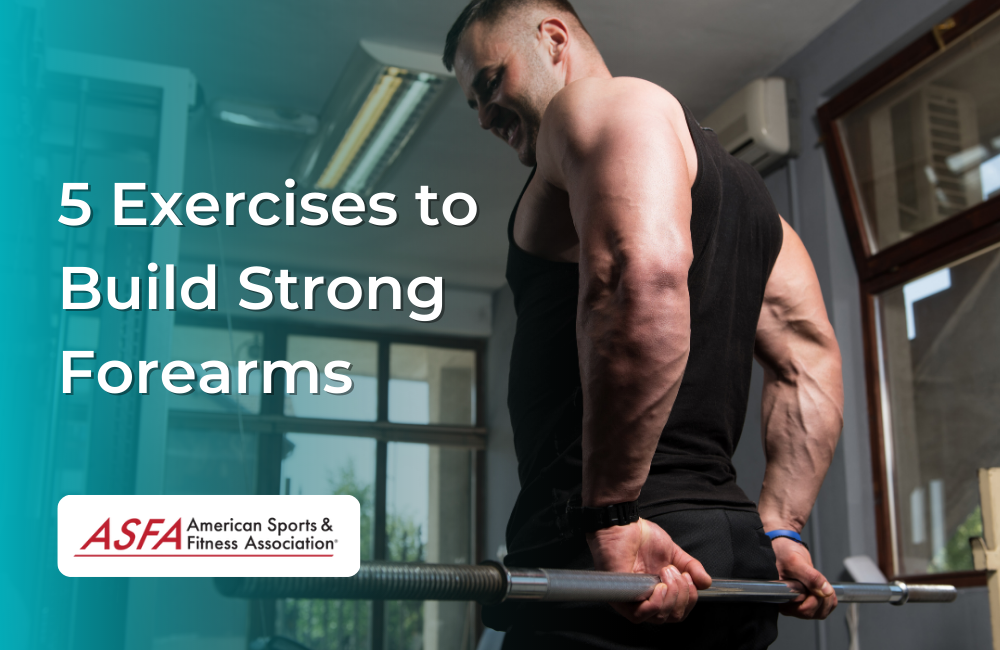
5 Exercises to Build Strong Forearms
5 Exercises to Build Strong Forearms is most useful when each item connects to a real training or coaching decision. A longer list is not automatically a better one.
Technique is not a single perfect shape. It is a repeatable way to complete the movement while controlling the load, range, and positions that matter for the goal. What follows is less about chasing novelty and more about applying the idea well.
Injury Prevention
Strengthening your forearms balances the muscles around your wrists and elbows, reducing the risk of common injuries like tendonitis or wrist strain.
How to Perform
- Sit on a bench with your forearms resting on your thighs, palms facing up, and wrists just beyond your knees.
- Hold a barbell with an underhand, shoulder width grip (palms up), letting the bar roll slightly into your fingers.
- Curl the bar upward by flexing your wrists while keeping your forearms stationary.
- Slowly lower the barbell back to the starting position, allowing it to roll slightly into your fingers for an added stretch.
- Perform 3–4 sets of 12–15 repetitions.
3. Farmer’s Walk
The farmer’s walk is a functional exercise that strengthens your grip and forearm muscles while improving overall stability and endurance. It’s one of the most effective ways to build real-world strength.
- Grab a pair of heavy dumbbells or kettlebells, one in each hand. The farmer's walk is an effective forearm exercise that helps strengthen and develop your forearms.
- Stand tall with your shoulders back, core engaged, and arms fully extended at your sides.
- Walk a set distance (20–30 yards) or for a set time (30–60 seconds) while maintaining good posture.
- Set the weights down, rest for 30 seconds, and repeat for 3–4 rounds.
1. Incorporate Variety
Rotate between these exercises to ensure all forearm muscles are targeted and to prevent plateaus in strength development.
4. Warm Up and Stretch
Warming up before forearm exercises and stretching afterward can improve flexibility, reduce stiffness, and lower the risk of injury.
Aesthetic Appeal
Well-developed forearms contribute to a balanced, muscular upper body that looks as strong as it feels.
A Necessary Safety Note
Exercise should be adjusted for the participant's experience, symptoms, environment, and available supervision. Stop for sharp pain, dizziness, chest discomfort, sudden weakness, or loss of control, and seek appropriate professional guidance when symptoms are persistent or concerning.
A Coach's Checklist
For instructors: Choose the variation that permits a stable setup and repeatable range. Add repetitions or resistance only while the same control is maintained; stop when pain or compensation changes the movement.
What to Remember
Keep the goal visible, make the smallest change that addresses it, and reassess before adding complexity.
Use Clear Criteria
Before applying 5 Exercises to Build Strong Forearms, define the outcome in terms that can be observed. That may be steadier technique, a tolerable training dose, better consistency, clearer client communication, or a decision between two reasonable options.
- Goal: State what should improve and why it matters.
- Starting point: Use the person's current ability, experience, equipment, and constraints.
- Dose: Decide how much work or change is appropriate before adding more.
- Feedback: Track technique, tolerance, consistency, and the response after the session.
A Repeatable Next Step
Keep the first adjustment modest. If the response is useful and repeatable, progress one variable—such as range, load, duration, complexity, or frequency. If the result is poor, change the limiting variable instead of assuming that more effort will solve it.
Apply the Idea With Restraint
With 5 Exercises to Build Strong Forearms, the same recommendation can produce different results for two people. Experience, recent workload, movement skill, available equipment, schedule, preferences, and recovery all change what is reasonable.
Review the result over several exposures rather than judging one unusually good or difficult session. Useful progress is usually visible as better control, a more appropriate workload, improved consistency, or clearer decision-making.
Use a Goal-First Framework
A strong plan for 5 Exercises to Build Strong Forearms connects technique with programming, recovery, and the participant’s current level of control.
Decide whether the priority is skill, strength, muscle development, mobility, work capacity, or general activity. That choice affects exercise order, range of motion, resistance, repetitions, rest, and frequency. A program becomes harder to evaluate when several goals are pursued in the same set without a clear priority.
Progress Without Losing the Original Goal
Start with a version that allows a stable setup and repeatable range. Establish a baseline for repetitions, load, tempo, and perceived effort. Progress one element—such as another repetition, a small resistance increase, more range, or a more demanding variation—only when the prior version remains controlled. If technique changes early, recovery declines, or the target area is no longer doing the intended work, reduce the demand and rebuild from a clearer baseline.
What to Review After Several Sessions
A short record is usually enough. Review:
- the variation and setup used
- where technique first changed
- whether the target goal improved across several sessions
- whether fatigue interfered with other training
Keep the review connected to the original goal. More information is not automatically better when the important result remains unclear.
Individual Context Still Matters
Exercise selection should fit the participant rather than require the participant to fit a preferred variation. A different stance, grip, range, resistance, or tool may preserve the goal more effectively. Use the version that allows a controlled and repeatable pattern, then progress from the response rather than from an arbitrary timetable.
What Not to Assume
- Changing exercises every session before a pattern can be evaluated.
- Letting speed hide a loss of position or control.
- Treating discomfort as a cue to push through rather than a reason to adjust and seek appropriate guidance when needed.
- Copying an advanced athlete’s program without matching training history or recovery.
The goal is not perfect control of every variable. It is enough consistency to make an informed next decision.
The Final Planning Questions
- Which variation allows the intended technique today?
- What load, range, tempo, and rest will be recorded?
- What sign will indicate that the set or session should stop?
- Which single variable may progress next?
- How will this work fit with the rest of the week?
- What is the primary training objective?
The checklist is intentionally practical: each answer should change how the plan is designed, delivered, or reviewed.
What to Change—and What to Keep Stable
The main programming variables are exercise selection, setup, range of motion, resistance, repetitions, sets, tempo, rest, frequency, and proximity to fatigue.
- Change one major variable at a time so the response can be interpreted.
- Keep technique standards consistent when load or repetitions increase.
- Use a version that fits the available equipment and the participant’s current control.
- Reduce range, resistance, speed, or complexity when quality begins to change.


