
Functional Cardio & Toning Workouts for Athletes
There is more to Functional Cardio & Toning Workouts for Athletes than one rule. Context determines which details deserve attention.
Technique is not a single perfect shape. It is a repeatable way to complete the movement while controlling the load, range, and positions that matter for the goal. Small setup choices can change the experience considerably.
Important Boundaries
Keep in mind: Choose the variation that permits a stable setup and repeatable range. Add repetitions or resistance only while the same control is maintained; stop when pain or compensation changes the movement.
The Importance of Functional Fitness for Athletes
Functional fitness is a training approach focused on improving how the body performs day-to-day activities and sport-specific movements. Instead of isolating muscles with machine-based exercises, functional training exercises engage multiple muscle groups and mimic the body’s natural movement patterns.
Key Characteristics of Functional Fitness
- Multi-muscle engagement: Functional exercises target several muscle groups simultaneously, leading to better coordination, balance, and overall strength.
- Sport-specific movement replication: Exercises mirror the motions athletes perform in their sport, making functional fitness highly effective for sport-specific development.
- Injury prevention: By strengthening stabilizing muscles, improving flexibility, and enhancing balance, functional fitness reduces the risk of injuries that are common in athletic performance.
1. Enhanced Strength
Functional exercises such as squats, lunges, and deadlifts work multiple muscle groups, leading to improved total-body strength and muscle gains. For athletes who need explosiveness—such as sprinters, basketball players, or football players—functional strength exercises are essential.
3. Better Agility and Coordination by Engaging Multiple Muscle Groups
By incorporating agility drills like cone drills, ladder exercises, and plyometrics, functional cardio workouts enhance speed, reaction time, and coordination—skills that are critical for most sports.
4. Injury Prevention
Functional exercises build core stability, flexibility, and balance, which play useful roles in injury prevention. Strengthening stabilizing muscles helps athletes avoid common injuries like sprains, strains, and joint issues.
Sample Functional Cardio & Toning Workout for Athletes
Here’s a well-rounded functional workout designed to improve strength, endurance, and agility for athletes of any level. It includes both cardio and toning exercises to give you a full-body workout that builds muscle and boosts cardiovascular health.
Functional Cardio Circuit (20 Minutes)
This cardio circuit focuses on improving cardiovascular endurance while boosting agility and coordination. Repeat the circuit three times with 1-minute rest between rounds.
- High Knees – 1 minute: Lift your knees to waist height while pumping your arms. This will increase your heart rate and improve coordination.
- Burpees – 1 minute: Start in a standing position, squat down, kick your legs out into a plank, perform a push-up, and jump back to standing. This full-body movement increases strength and cardiovascular endurance, engaging both the lower and upper body.
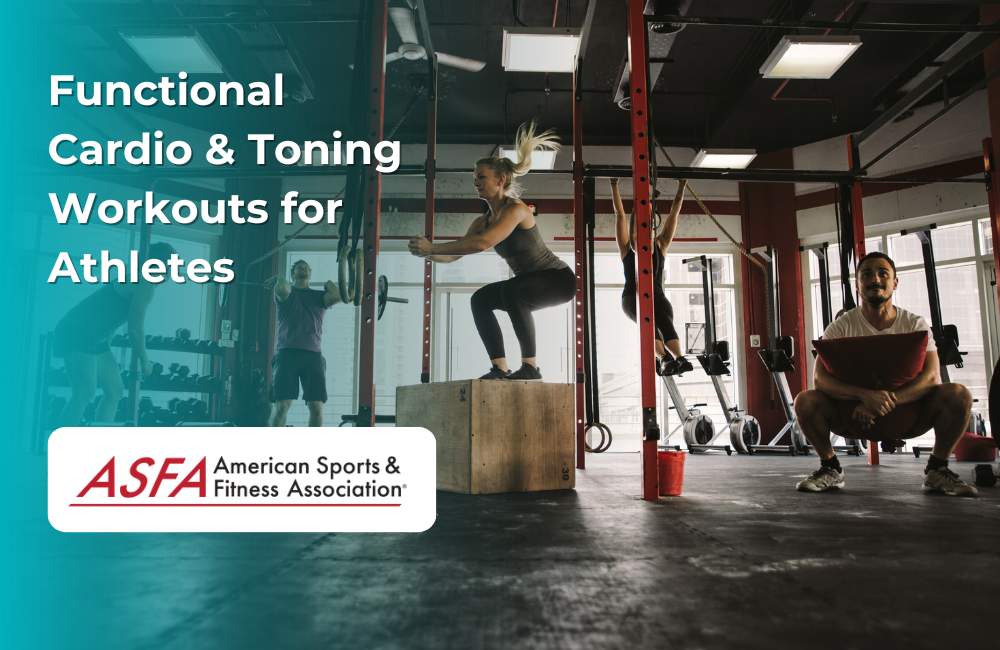
- Box Jumps or Step-ups – 1 minute: Using a box or step, jump or step onto the surface, land softly, and then step or jump back down. This exercise builds explosive power in the legs.
- Mountain Climbers – 1 minute: Begin in a plank position and alternately drive your knees toward your chest, engaging your core and keeping a fast pace.
Cool-Down (10 Minutes)
The cool-down phase focuses on stretching and recovery to promote flexibility and reduce muscle soreness.
- Static stretching for major muscle groups (hamstrings, quads, shoulders, calves) – 5 minutes.
- Deep breathing exercises to lower your heart rate and relax your muscles – 2 minutes.
- Foam rolling to release muscle tension and promote recovery – 3 minutes.
1. Sport-Specific Movements
- For Basketball: Focus on explosive movements like box jumps, lateral shuffles, and medicine ball slams to mimic jumping and fast direction changes.
- For Soccer: Incorporate agility drills like cone drills, ladder exercises, and sprints to improve footwork, speed, and dynamic leg strength.
- For Tennis: Add lateral lunges, rotational exercises, and agility ladder drills to enhance agility and coordination during quick direction changes.
3. Functional Tools
Incorporating functional fitness accessories can help athletes challenge their bodies in new ways. These tools include:
- Resistance bands: Add resistance to squats, lunges, and presses.
- Medicine balls: Use for rotational movements and power-building exercises like slams.
- Agility cones: Great for improving speed, agility, and reaction time through drills.
- Kettlebells: Versatile for strength and cardio, they can be used for swings, deadlifts, and cleans.
Safety and Progression
When it comes to functional fitness exercises, safety and progression are important. It’s essential to start with exercises that are within your fitness level and gradually progress to more challenging movements.
Here are some safety tips to keep in mind:
- Always warm up before starting a workout
- Start with lighter weights and gradually increase the load
- Focus on proper form and technique
- Listen to your body and rest when needed
- Avoid overtraining and allow for recovery time
Maximizing Functional Fitness
To maximize functional fitness, it’s essential to incorporate a variety of exercises into your workout routine. Here are some tips to help you get the most out of your functional fitness workouts:
- Incorporate compound exercises that work multiple muscle groups at once
- Use a variety of equipment, such as free weights, resistance bands, and kettlebells
- Incorporate cardio exercises to improve cardiovascular fitness
- Focus on proper form and technique
- Gradually increase the intensity and difficulty of your workouts
- Incorporate functional exercises that mimic real-life movements
ASFA Functional Fitness Certification
For athletes or fitness professionals looking to deepen their understanding of functional training, ASFA offers a Functional Fitness Certification. This certification provides the knowledge and skills needed to design sport-specific training programs, select functional exercises, and understand injury prevention strategies.
Put It Into Practice
Good coaching leaves room for feedback. If the response does not match the goal, adjust the dose, range, exercise, or expectation.

Turn the Information Into a Decision
Functional Cardio & Toning Workouts for Athletes becomes more practical when the exercise choice, training dose, and progression method all point toward the same outcome.
For strength, the plan may emphasize load and long rest periods. For muscular endurance, the same movement may use lighter resistance, more repetitions, and shorter recovery. Technique practice may call for low fatigue and frequent high-quality repetitions. Conditioning may use a different structure again. Those approaches are not interchangeable simply because the exercise name is the same.
Keep the Recommendation Proportional
Two people can use the same exercise for different reasons and need different versions. Training history, limb proportions, mobility, confidence, equipment, schedule, symptoms, and the rest of the program all affect the decision. Standardize the objective and the tracking method; individualize the setup and dose. That balance makes comparisons more useful without forcing every repetition to look identical.
Mistakes That Make the Result Harder to Read
- Choosing the hardest variation before the base movement is controlled.
- Increasing load, repetitions, range, and frequency at the same time.
- Using fatigue or soreness as the only evidence of an effective session.
- Forcing a standardized range or stance when another controlled setup better fits the participant.
The correction is straightforward: return to the objective, simplify the setup, and change only what the available feedback supports.


