

Recommended Texts & Manuals
Youth Fitness Trainer Certification
Youth Fitness Trainer Certification
Earn your Youth Fitness Trainer Certification and create engaging, age-appropriate programs that build movement skills, confidence, and healthy activity habits.
Pay Only If You Pass
Fully Accredited
100% Online & Self-Paced
No Required Coursework
Instant Digital Certificate
100,000+ Certifications Issued Worldwide
Couldn't load pickup availability
About Our Youth Fitness Trainer Certification
Young People Need More Reasons to Move, Not More Reasons to Feel Judged
Youth fitness can influence how children and adolescents think about movement for years. A well-led program builds competence, curiosity, confidence, and positive habits. A poorly designed one can make exercise feel like punishment, comparison, or another place where a young person is told they are not good enough.
ASFA's Youth Fitness Trainer Certification recognizes knowledge of age-aware exercise, movement fundamentals, strength and conditioning, engagement, progression, communication, safety, and professional boundaries. It is intended for trainers, coaches, educators, recreation professionals, and prepared fitness enthusiasts who want to work responsibly with younger populations.
Candidates may take the examination before paying. If you pass, decide whether to purchase the credential. If you do not pass, there is no charge. Use the result to guide further study and return when prepared.
After you pass and complete checkout, your digital certificate is normally emailed within minutes.
What Is a Youth Fitness Trainer Certification?
A Youth Fitness Trainer Certification is a specialty credential that recognizes knowledge of fitness programming for children and adolescents. It addresses age-appropriate instruction, core movement skills, basic strength development, conditioning, coordination, motivation, group management, and safety.
The credential does not replace teaching licenses, sport-specific coaching requirements, background checks, safeguarding training, CPR qualifications, or organizational policies. Those requirements depend on the role and setting.
Development Is Not a Smaller Version of Adult Training
Young participants differ in physical maturity, attention, confidence, experience, and motivation. Two children of the same age may need very different levels of instruction and challenge. Programming should therefore be flexible enough to respect development without turning age into a rigid prediction of ability.
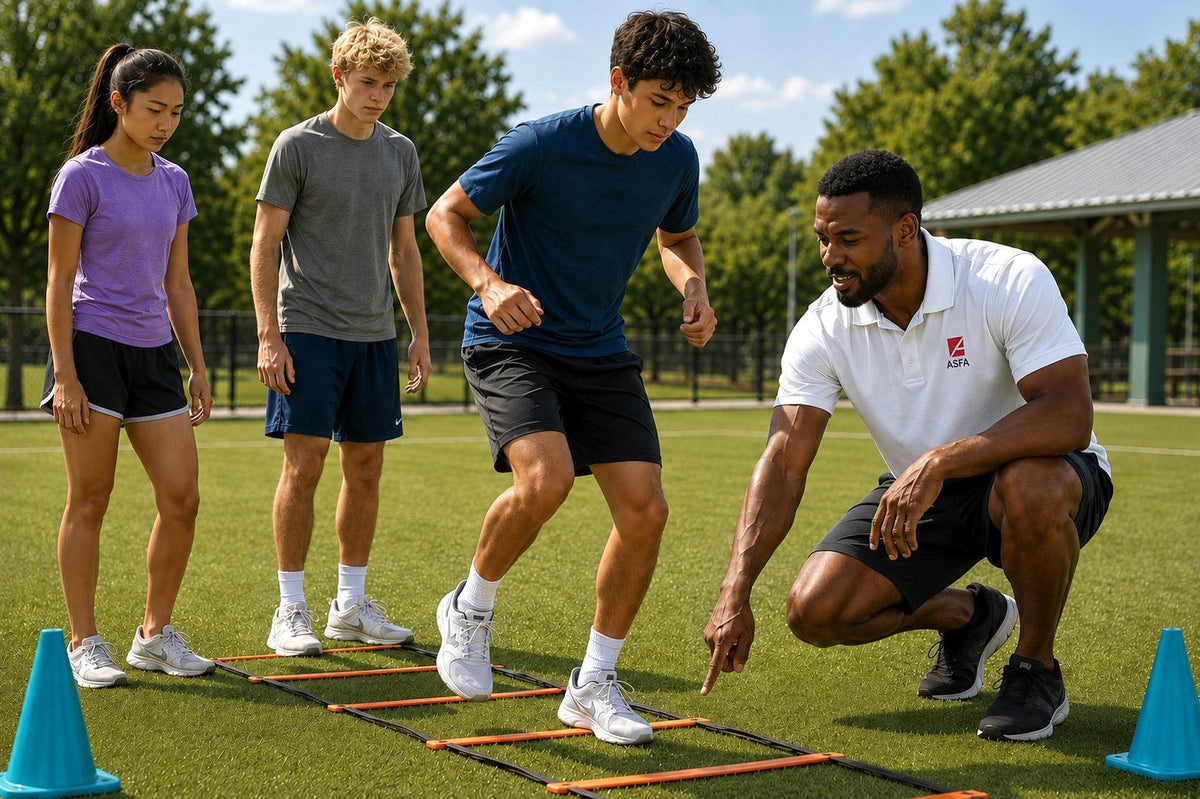
Core movement matters. Running, jumping, landing, throwing, catching, balancing, changing direction, pushing, pulling, and carrying can create a broad base for activity. These skills can be taught through games, circuits, practice, and structured exercise without forcing children into adult bodybuilding routines.
Strength training can be appropriate when technique, supervision, progression, and equipment match the participant. The goal is not to chase maximal numbers or compare children publicly. It is to develop control, competence, and an understanding of how to train safely.
What the Examination Calls on You to Understand
- Age-aware programming: matching instruction and complexity to the participant rather than copying an adult session.
- Movement fundamentals: teaching basic patterns that support confidence and broad physical literacy.
- Strength and conditioning: using appropriate resistance, repetition, technique, and progression.
- Coordination and agility: creating drills that are purposeful, scalable, and engaging.
- Communication: giving clear directions, checking understanding, and avoiding language that embarrasses or labels participants.
- Motivation: balancing challenge, choice, play, skill development, and measurable progress.
- Group management: organizing space, equipment, transitions, and supervision.
- Safeguarding and scope: respecting boundaries, reporting requirements, parental expectations, and the limits of fitness practice.
Make Success Visible Without Making It a Ranking
Young people benefit from progress they can recognize: smoother technique, another controlled repetition, improved balance, better pacing, or the confidence to attempt a new activity. Those wins do not require a leaderboard.
Competition can be enjoyable when it is appropriate and well managed. However, constant comparison may discourage the very participants who most need a positive experience with movement. A capable youth fitness trainer knows when competition adds energy and when cooperation, skill practice, or individual goals would serve the group better.
Working With Parents and Organizations
Youth instruction rarely involves only the trainer and participant. Parents, guardians, schools, clubs, and recreation programs may all have expectations. Communication should be clear about goals, supervision, attendance, behavior, emergency procedures, and what the program does and does not provide.
Fitness professionals should never diagnose a child, prescribe treatment, or make unsupported claims about growth, weight, or health. Concerns outside the program should be referred through the appropriate parent, guardian, organizational, or healthcare channel.
Who May Be Ready to Test?
The certification may fit personal trainers, sport coaches, physical educators, youth program staff, recreation leaders, and aspiring professionals with a strong understanding of fitness principles. Serious enthusiasts are also allowed to test.
Passing an online examination validates knowledge. It does not bypass legal or organizational safeguards for working with minors. Candidates should expect employers to require background screening, CPR, safeguarding education, practical experience, or other credentials.
ASFA's Test-First Process
Take the examination online when you believe you are ready. If you pass, choose and purchase the certification option you want. If you do not pass, you are not charged. Study the areas that need improvement and try again later.
ASFA is fully accredited by the International Council for Online Educational Standards (ICOES). The youth fitness examination is completed online at your own pace.
Professional Value
A youth specialty can support work in gyms, recreation centers, sport programs, camps, schools, community organizations, or private training. It may help a trainer communicate that youth programming is an intentional service rather than an afterthought.
Marketability still depends on trust. Parents and organizations evaluate more than a credential. They consider communication, judgment, reliability, safety practices, experience, and the way the trainer treats young people.
Frequently Asked Questions
Can I work with children immediately after passing?
The certification does not override employer, legal, insurance, safeguarding, background-check, or CPR requirements. Confirm every requirement for the setting where you plan to work.
Does youth fitness include strength training?
It may. Appropriate youth strength training emphasizes supervision, technique, controlled progression, and developmentally suitable exercise rather than adult maximal-lifting practices.
Can a beginner take the exam?
Yes. ASFA allows aspiring professionals to test. If the candidate is not ready and does not pass, no payment is required.
Is ASFA fully accredited?
Yes. ASFA is fully accredited by the International Council for Online Educational Standards (ICOES).
Will employers accept the certification?
Policies vary. Youth programs may have stricter requirements than general fitness facilities. Ask about accepted credentials, background screening, safeguarding, CPR, and experience.
Does the certification qualify me to provide medical or developmental advice?
No. It recognizes fitness instruction knowledge. Clinical, developmental, therapeutic, and dietary concerns require appropriately qualified professionals.
Related Certifications for Youth and Athletic Development
Useful complementary credentials include the Personal Trainer Certification, Sport Specific Trainer Certification, Speed & Agility Coach Certification, Recreation Instructor Certification, and Health & Wellness Coach Certification.
Youth fitness succeeds when young people leave feeling more capable than when they arrived. The program should build skill, not just produce fatigue.