
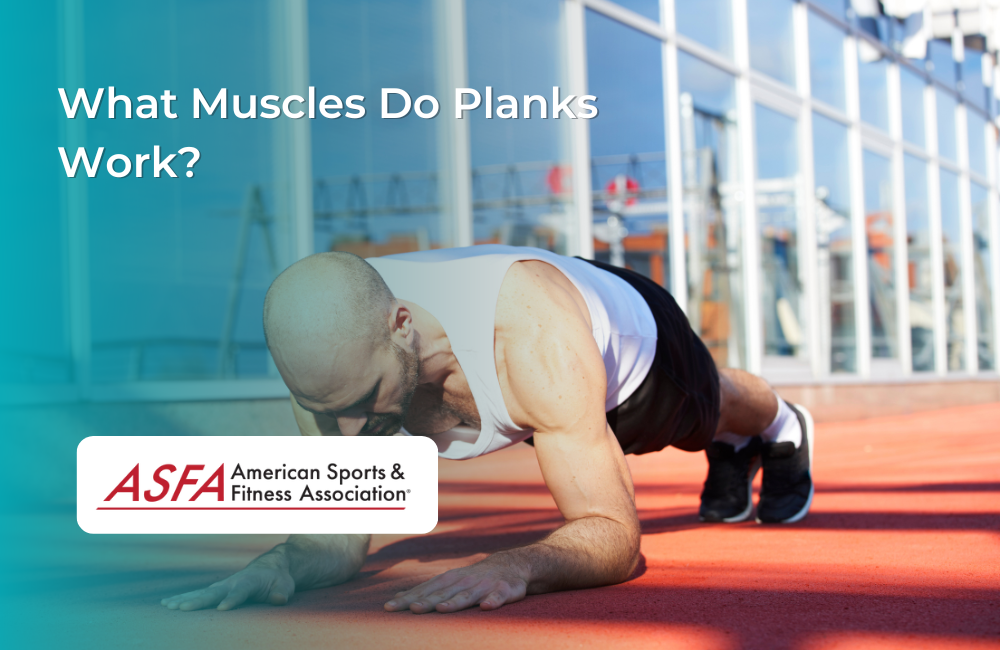
What Muscles Do Planks Work?
A plank is an isometric trunk exercise: the muscles create tension while the body holds a stable position. Although planks are commonly described as an abdominal exercise, they involve the shoulders, back, hips, and legs as well.
Primary Muscles Used in a Front Plank
- Rectus abdominis: helps resist excessive extension of the lower back.
- Internal and external obliques: help control rotation and side bending.
- Transverse abdominis and deeper trunk muscles: contribute to abdominal bracing.
- Serratus anterior: helps stabilize the shoulder blades against the rib cage.
- Deltoids and triceps: support the upper body in a high plank.
- Gluteal muscles and quadriceps: help keep the hips and knees extended.
How to Perform a Forearm Plank
- Place the forearms on the floor with the elbows under or slightly in front of the shoulders.
- Extend the legs and place the feet at a width that provides stable support.
- Brace the abdomen and contract the glutes so the ribs, pelvis, and legs remain organized.
- Press the forearms into the floor without shrugging the shoulders.
- Hold only as long as you can breathe steadily and maintain position.
Plank Variations
Incline Plank
Place the hands or forearms on a stable bench. The incline reduces the load and is a useful starting point.
High Plank
Hold the top of a push-up with the hands under the shoulders. This variation adds more demand to the wrists and triceps.
Side Plank
Support the body on one forearm and the side of one foot, or bend the lower knee for assistance. Side planks emphasize the lateral trunk and hip muscles.
Plank with Shoulder Tap
From a high plank, lift one hand to tap the opposite shoulder while limiting torso rotation. Widen the feet or use an incline to make the drill more manageable.
Common Errors
- Holding so long that the hips sag or rise substantially.
- Holding the breath.
- Letting the shoulders collapse toward the floor.
- Progressing to unstable or moving variations before controlling a basic hold.
Longer holds are not automatically better. Add difficulty by improving tension, changing leverage, or adding controlled movement. ASFA's Core Fitness Training Certification covers additional trunk-training concepts.
Practical Takeaway
Planks train the trunk as part of a full-body support system. Choose a version that allows steady breathing and a stable body line, then progress without letting duration replace quality.
How to Perform a Front Plank
Place the forearms on the floor with the elbows under or slightly in front of the shoulders. Extend the legs, squeeze the glutes lightly, and keep the ribs and pelvis controlled. Breathe behind the brace instead of holding the breath.
Why Plank Position Changes the Demand
Moving the elbows farther forward lengthens the lever and makes the exercise harder. Elevating the hands or forearms shortens the lever and reduces difficulty. Lifting an arm or leg adds an anti-rotation demand. More time is only one way to progress.
Useful Variations
- Elevated plank: A scalable starting point.
- High plank: Uses a push-up position and adds wrist loading.
- Side plank: Emphasizes lateral trunk control.
- Long-lever plank: Increases demand by moving the elbows forward.
- Plank shoulder tap: Adds controlled anti-rotation.
Programming
Use short, high-quality holds of ten to thirty seconds and repeat them. Stop when the lower back sags, the hips rise sharply, or breathing cannot be maintained. For many trainees, harder variations and controlled repetitions are more useful than holding an easy plank for several minutes.
Common Errors
- Holding the breath.
- Allowing the shoulders to collapse between the arms.
- Tilting the head up to look forward.
- Continuing after trunk position is lost.
- Using planks as the only trunk exercise.
Building a Complete Trunk Program
Combine planks with carries, dead bugs, bird dogs, controlled spinal movement, and loaded compound exercises. The trunk must resist extension, rotation, and side bending, but it also produces and transfers movement in sport and daily activity.
Are Long Planks Better?
Long holds mainly show endurance in that specific variation. Once a person can hold a standard plank for a substantial time with good position, use a longer lever, external load, controlled limb movement, or another trunk exercise instead of extending the timer indefinitely.
The progression should remain measurable and should not turn a trunk exercise into a test of shoulder discomfort or boredom.


