
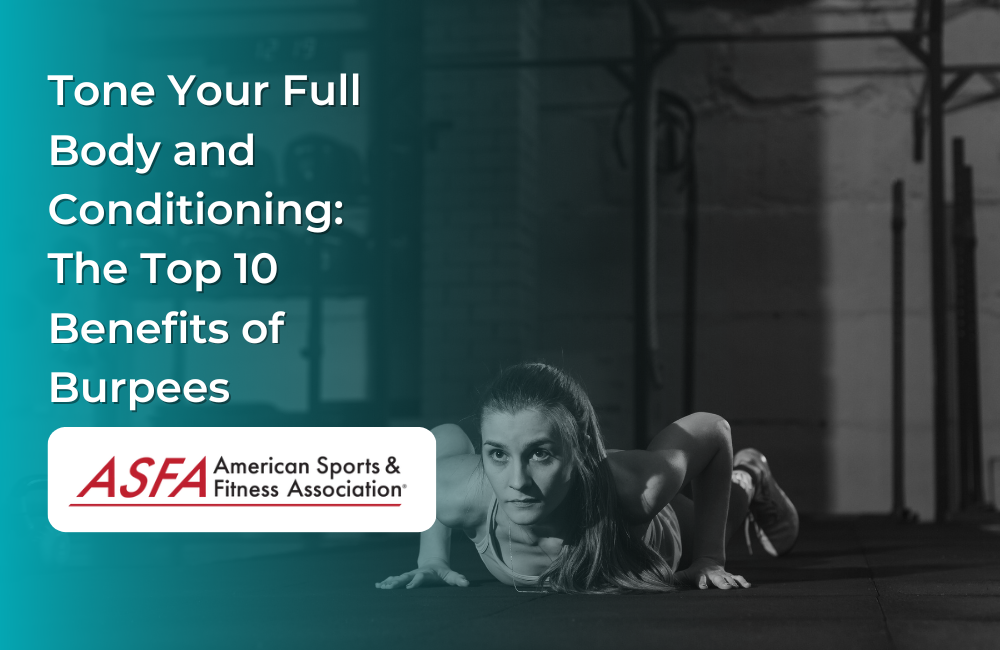
The Top 10 Benefits of Burpees
The points in The Top 10 Benefits of Burpees are organized around practical application rather than exaggerated promises.
Technique is not a single perfect shape. It is a repeatable way to complete the movement while controlling the load, range, and positions that matter for the goal. The distinction matters in practice.
Full-Body Workout
One of the primary advantages of burpees is that they target multiple muscle groups across the body, providing a complete full-body workout. This dynamic exercise targets various muscle groups, including the chest, shoulders, triceps, abdominals, quads, glutes, and hamstrings.
Improved Cardiovascular Fitness through High Intensity Interval Training (HIIT)
Burpees are a high-intensity exercise that requires quick and explosive movements. This intensity not only helps build muscle strength but also significantly improves cardiovascular fitness.
Enhanced Fat Burning and Weight Loss
As a high-intensity, full-body workout, burpees burn a significant number of calories and are highly effective in promoting weight loss by helping you burn calories and fat. The combination of strength training and cardiovascular exercise in a single movement increases your metabolism, helping you burn more calories during and after your workout.
Increased Power and Agility
Burpees require a combination of strength, power, and agility. The explosive nature of the exercise helps develop fast-twitch muscle fibers, which are responsible for generating force and speed.
Improved Balance and Coordination
The complex sequence of movements involved in a burpee challenges your balance and coordination. As you transition from a squat to a plank, then back to a squat and finally jump, your body must continually adapt to maintain stability.
No Equipment Required
One of the most appealing aspects of burpees is that they are a bodyweight resistance exercise that does not require any specialized equipment. All you need is a bit of space and your body weight.
Increased Mental Toughness and Resilience
Burpees are a challenging exercise that requires mental fortitude to perform. Pushing through the challenge of completing a set of burpees can help you build mental toughness and resilience, which are valuable traits in all areas of life.
Customizable and Adaptable
Burpees can be easily adapted to suit your fitness level or to target specific muscle groups. If you’re new to burpees or want to reduce the intensity, you can modify the exercise by stepping back into the plank position instead of jumping, or by eliminating the jump at the end.
Improved Core Strength
A strong core is essential for overall stability, balance, and injury prevention. Burpees effectively engage your core muscles, including the abdominals, obliques, and lower back, throughout the entire movement.
Time-Efficient Workout
In today's busy world, finding time for exercise can be challenging. Burpees offer a time-efficient solution, providing a full-body workout that can be completed in a relatively short period.
Tips for Proper Burpee Technique
To maximize the benefits of burpees and minimize the risk of injury, it’s essential to use proper form. Follow these tips to ensure you’re performing burpees correctly:
- Begin in a standing position with your feet shoulder-width apart and your arms at your sides.
- Squat down, placing your hands on the ground in front of you, just outside of your feet.
- Jump or step both feet back, landing in a push-up position with your body in a straight line from your head to your heels.
- (Optional) Perform a push-up by lowering your chest to the ground, then pressing back up to the push-up position.
- Jump or step your feet forward to return to the squat position, with your hands still on the ground.
- Stand up and jump, reaching your arms overhead. Land softly, and immediately begin the next repetition.
Decision Points
Practical point: Choose the variation that permits a stable setup and repeatable range. Add repetitions or resistance only while the same control is maintained; stop when pain or compensation changes the movement.
Limits and Safety
Exercise should be adjusted for the participant's experience, symptoms, environment, and available supervision. Stop for sharp pain, dizziness, chest discomfort, sudden weakness, or loss of control, and seek appropriate professional guidance when symptoms are persistent or concerning.
Final Coaching Note
The best application is specific enough to guide action and flexible enough to change when the person or circumstances change.

Start With the Decision That Matters
A strong plan for The Top 10 Benefits of Burpees connects technique with programming, recovery, and the participant’s current level of control.
For strength, the plan may emphasize load and long rest periods. For muscular endurance, the same movement may use lighter resistance, more repetitions, and shorter recovery. Technique practice may call for low fatigue and frequent high-quality repetitions. Conditioning may use a different structure again. Those approaches are not interchangeable simply because the exercise name is the same.
Know When the Plan Needs to Change
A short record is usually enough. Review:
- whether the target goal improved across several sessions
- whether fatigue interfered with other training
- the variation and setup used
- where technique first changed
When the response differs from the expectation, revisit the setup and assumptions before adding more volume, restriction, or complexity.
Context Changes the Best Choice
Two people can use the same exercise for different reasons and need different versions. Training history, limb proportions, mobility, confidence, equipment, schedule, symptoms, and the rest of the program all affect the decision. Standardize the objective and the tracking method; individualize the setup and dose. That balance makes comparisons more useful without forcing every repetition to look identical.
Avoid These Planning Errors
- Increasing load, repetitions, range, and frequency at the same time.
- Using fatigue or soreness as the only evidence of an effective session.
- Forcing a standardized range or stance when another controlled setup better fits the participant.
- Choosing the hardest variation before the base movement is controlled.
The correction is straightforward: return to the objective, simplify the setup, and change only what the available feedback supports.
Put the Guidance Through This Test
- Which variation allows the intended technique today?
- What load, range, tempo, and rest will be recorded?
- What sign will indicate that the set or session should stop?
- Which single variable may progress next?
- How will this work fit with the rest of the week?
- What is the primary training objective?
This review keeps the next step tied to the topic while leaving room for individual judgment and feedback.
The Details That Alter the Outcome
Small programming changes can make the same movement serve a different purpose. Slower repetitions increase time under tension; longer rest may preserve force; shorter rest changes the conditioning demand; additional range can increase difficulty even without more weight.
- Progress only while the intended movement pattern remains recognizable.
- Choose the variable that best matches the current goal.
- Record enough detail to repeat the session accurately.
- Do not treat fatigue as proof that the exercise was well selected.


