
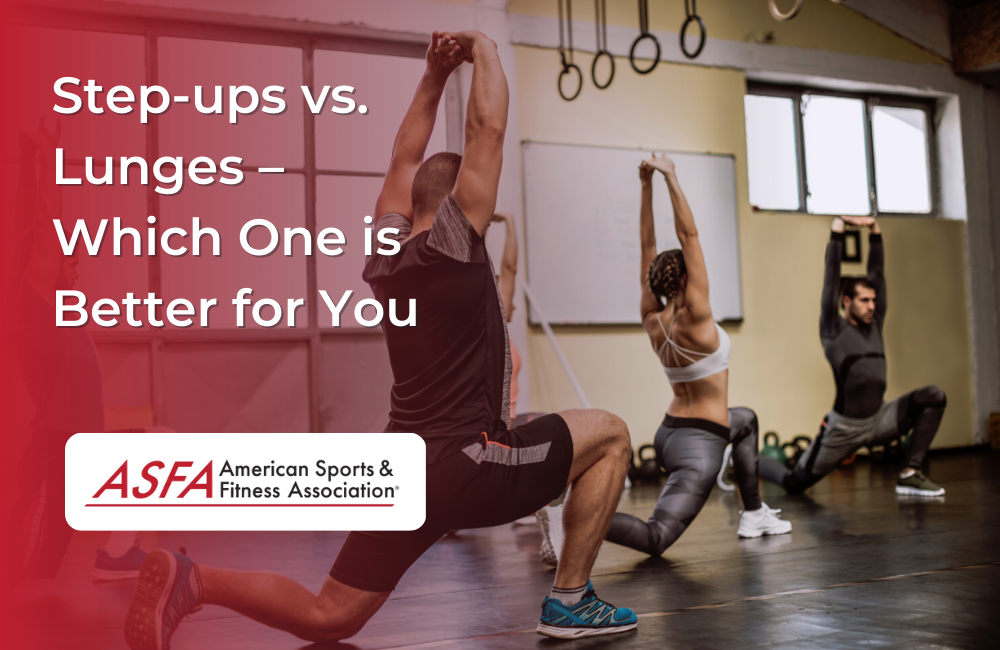
Step-ups vs. Lunges
Choosing between two training options starts with the job each one needs to do. Step-ups vs. Lunges is therefore a question of fit, not a search for an absolute winner.
Technique is not a single perfect shape. It is a repeatable way to complete the movement while controlling the load, range, and positions that matter for the goal. The next sections turn that principle into specific decisions.
Programming Considerations
A useful checkpoint: Choose the variation that permits a stable setup and repeatable range. Add repetitions or resistance only while the same control is maintained; stop when pain or compensation changes the movement.
What Are Step-Ups and Lunges?
Step-ups and lunges are both compound exercises, meaning they involve multiple joints and muscle groups. These exercises target specific muscle groups such as the glutes, quads, and hamstrings, making them essential for a well-rounded lower-body workout.
Step-Ups
Step-ups involve stepping up onto a raised platform or box with one foot and then bringing the other foot up to meet it, followed by stepping down and repeating the movement. This exercise primarily targets the quadriceps and glutes but also engages the hamstrings and calves.
Similarities
- Quadriceps: Both exercises heavily engage the quadriceps, the muscles located on the front of the thighs, responsible for extending the knee joint.
- Glutes: The gluteal muscles, which include the gluteus maximus, medius, and minimus, are activated during both step-ups and lunges. These muscles play an important role in hip extension and stabilization.
- Hamstrings: Both exercises involve the hamstrings, located on the back of the thighs. These muscles assist with knee flexion and hip extension.
- Calves: The calves are involved in both movements, helping with the push-off phase during step-ups and lunges, particularly in variations that involve an upward motion like plyometric lunges or step-ups.
Cardio Benefits of Step-Ups and Lunges
Both step-ups and lunges offer cardiovascular benefits, especially when performed in higher repetitions or as part of a circuit training routine. Step-ups are particularly effective for building muscle endurance and stability in the lower body, which can enhance overall strength and agility.
- Cardio Intensity: Step-ups can elevate your heart rate significantly, especially when performed at a fast pace or with added resistance (e. G.
- Functional Cardio: Since step-ups mimic real-life movements like climbing stairs, they improve both cardiovascular fitness and functional strength, enhancing your ability to perform daily activities with greater ease.
Leg Strength Benefits and Drawbacks of Each Exercise
Benefits: Step-ups are excellent for building lower body strength, improving balance, and increasing agility. They target the quads and glutes effectively and can be adapted for different fitness levels by adjusting the height of the step or adding resistance.
Drawbacks: The main drawback of step-ups is that they require proper form to avoid injury, particularly in the knees and lower back. Also, access to a sturdy box or bench is necessary, which might not be available in all workout environments.
Weekly Legs Workout Plan Incorporating Step-Ups and Lunges
Here’s a comprehensive weekly workout plan that incorporates both step-ups and lunges, along with other lower body exercises to build strength, endurance, and stability.
Day 1: Strength and Stability
- Warm-Up (5-10 minutes): Dynamic stretches (leg swings, hip circles ), light cardio (jogging or cycling)
- Step-Ups: 4 sets of 10-12 reps per leg (use dumbbells for added resistance)
- Forward Lunges: 4 sets of 10 reps per leg
- Romanian Deadlifts: 3 sets of 8-10 reps
- Lateral Step-Ups: 3 sets of 8-10 reps per leg
- Core Work: Plank (3 sets of 60 seconds)
Day 2: HIIT and Agility
- Warm-Up (5-10 minutes): Dynamic stretches, jump rope
- Plyometric Lunges: 4 sets of 12-15 reps per leg
- Box Jumps: 4 sets of 8-10 reps
- Side-to-Side Speed Skaters: 4 sets of 15-20 reps
- Lunge-to-Step-Up Combo: 3 sets of 10-12 reps per leg (alternate between a forward lunge and a step-up)
Day 4: Strength and Power
- Warm-Up (5-10 minutes): Dynamic stretches, light cardio
- Reverse Lunges: 4 sets of 10-12 reps per leg
- Weighted Step-Ups: 4 sets of 8-10 reps per leg (increase step height for added challenge)
- Bulgarian Split Squats: 3 sets of 8-10 reps per leg
- Calf Raises: 3 sets of 15-20 reps
- Core Work: Russian Twists (3 sets of 20 reps per side)
Day 5: Cardio and Endurance
- Warm-Up (5-10 minutes): Dynamic stretches, light jogging
- Walking Lunges: 4 sets of 20 reps (10 per leg)
- Step-Up Intervals: 4 sets of 30 seconds on, 30 seconds off (as many step-ups as possible within the time)
- Mountain Climbers: 4 sets of 30 seconds
- Cool-Down (5-10 minutes): Static stretching, focusing on quads, hamstrings, and calves
Which Exercise is Better for You – Step-Ups or Lunges?
The answer to this question largely depends on your individual goals and preferences. Step-Ups are ideal for building lower body strength, particularly in the quads and glutes, and can be easily scaled by adjusting the height of the step or adding resistance.
The Practical Takeaway
Use the information to make one clear adjustment, then judge the result from repeatable performance rather than novelty.
Connect the Topic to a Real Objective
Applying the ideas in Step-ups vs. Lunges starts with a clear training objective rather than copying a movement, drill, or weekly schedule without context.
Decide whether the priority is skill, strength, muscle development, mobility, work capacity, or general activity. That choice affects exercise order, range of motion, resistance, repetitions, rest, and frequency. A program becomes harder to evaluate when several goals are pursued in the same set without a clear priority.
Track Enough to Make the Next Decision
A practical review includes:
- whether fatigue interfered with other training
- the variation and setup used
- where technique first changed
- whether the target goal improved across several sessions
Look for a pattern across several comparable attempts. One unusually good or difficult day should not determine the entire plan.
Context Changes the Best Choice
Exercise selection should fit the participant rather than require the participant to fit a preferred variation. A different stance, grip, range, resistance, or tool may preserve the goal more effectively. Use the version that allows a controlled and repeatable pattern, then progress from the response rather than from an arbitrary timetable.
Common Ways the Idea Gets Misapplied
- Changing exercises every session before a pattern can be evaluated.
- Letting speed hide a loss of position or control.
- Treating discomfort as a cue to push through rather than a reason to adjust and seek appropriate guidance when needed.
- Copying an advanced athlete’s program without matching training history or recovery.
A clear plan does not remove uncertainty, but it makes the next adjustment more responsible and easier to explain.
A Practical Review Checklist
- What is the primary training objective?
- Which variation allows the intended technique today?
- What load, range, tempo, and rest will be recorded?
- What sign will indicate that the set or session should stop?
- Which single variable may progress next?
Use the answers as the baseline for the next decision rather than relying on a vague impression of progress.


