
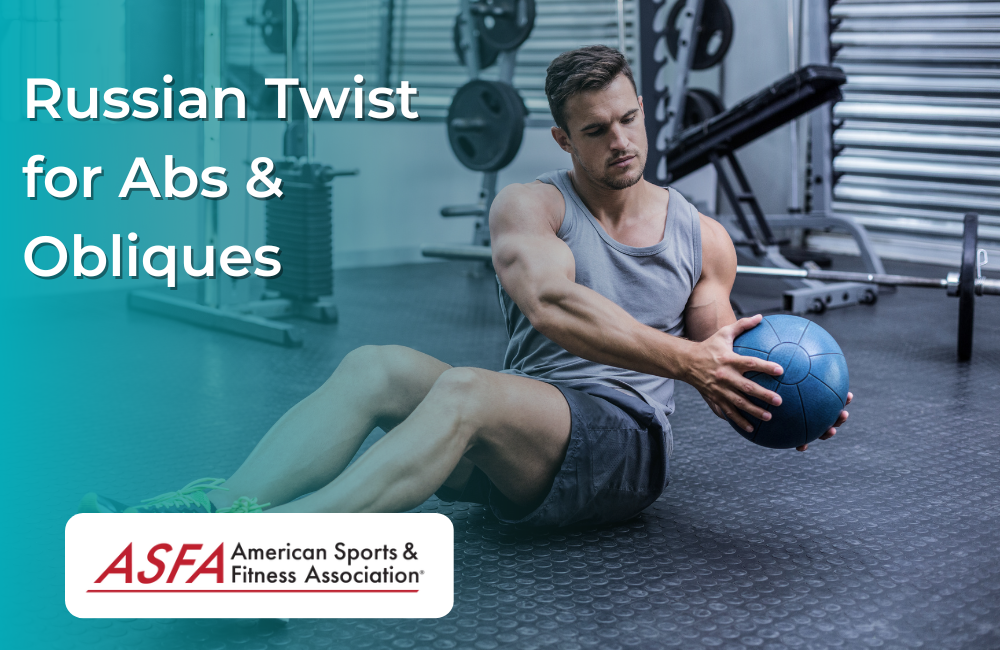
Russian Twist for Abs & Obliques
The clearest way to discuss Russian Twist for Abs & Obliques is to narrow the claims and state the practical limits plainly.
Core training is about controlling the trunk while the limbs move or external forces change. More fatigue is not automatically better control. There is room for individual preference, provided the basic constraints are respected.
When to Modify or Stop
Exercise should be adjusted for the participant's experience, symptoms, environment, and available supervision. Stop for sharp pain, dizziness, chest discomfort, sudden weakness, or loss of control, and seek appropriate professional guidance when symptoms are persistent or concerning.
Strengthen Your Core
Russian twists are one of the most effective exercises for strengthening your core muscles, including your abs and obliques. A strong core is essential for overall fitness and can help improve your posture, balance, and stability during physical activities.
Improve Your Balance
Russian twists require you to maintain your balance while twisting your torso, which helps improve your overall balance and coordination. Improved balance can also help prevent falls and injuries.
Increase Your Flexibility
Performing Russian twists regularly can help increase your overall flexibility, especially in your lower back and hips. Improved flexibility can help reduce your risk of injury and improve your overall athletic performance.
Boost Your Endurance
Russian twists are a high-intensity exercise that can help improve your endurance and stamina. Incorporating this exercise into your workout routine can help you push past your limits and improve your overall cardiovascular fitness.
Burn Calories
Russian twists are a great exercise for burning calories and losing weight. This exercise engages multiple muscle groups, which helps increase your metabolism and burn calories more efficiently.
Tone Your Waistline
Russian twists target your oblique muscles, which are located on the sides of your waistline. This exercise can help tone and define your waistline, giving you a more sculpted and toned appearance.
Improve Your Athletic Performance
Russian twists can help improve your overall athletic performance by strengthening your core, improving your balance and coordination, and increasing your endurance. This exercise can help you perform better in sports and other physical activities.
Reduce Your Risk of Back Pain
Performing Russian twists regularly can help strengthen your lower back muscles, which can help reduce your risk of back pain and improve your overall posture.
Improve Your Golf Swing
Russian twists can help improve your golf swing by strengthening your core and increasing your flexibility. A stronger core can help you generate more power and accuracy in your swing.
Increase Your Mind-Muscle Connection
Russian twists require you to engage your mind-muscle connection, which helps you to focus on the muscles you are working and maximize the effectiveness of the exercise. This can help you develop better body awareness and improve your overall exercise technique.
To incorporate Russian twists into your workout routine, start by sitting on the floor with your knees bent and your feet flat on the ground. Hold a weight, such as a medicine ball or a dumbbell, with both hands, and lean back slightly.
Next-Step Perspective
A sound plan does not need to look dramatic. It needs to be understandable, repeatable, and appropriate for the person using it.
How to Apply It
Coach's note: Core exercises should match the position the participant can control. Increase lever length, load, or movement one variable at a time rather than using discomfort as a progress marker.
Keep the Method Connected to the Goal
With Russian Twist for Abs & Obliques, the same recommendation can produce different results for two people. Experience, recent workload, movement skill, available equipment, schedule, preferences, and recovery all change what is reasonable.
Review the result over several exposures rather than judging one unusually good or difficult session. Useful progress is usually visible as better control, a more appropriate workload, improved consistency, or clearer decision-making.
Define the Purpose Before Adding More
A strong plan for Russian Twist for Abs & Obliques connects technique with programming, recovery, and the participant’s current level of control.
For strength, the plan may emphasize load and long rest periods. For muscular endurance, the same movement may use lighter resistance, more repetitions, and shorter recovery. Technique practice may call for low fatigue and frequent high-quality repetitions. Conditioning may use a different structure again. Those approaches are not interchangeable simply because the exercise name is the same.
Context Changes the Best Choice
Exercise selection should fit the participant rather than require the participant to fit a preferred variation. A different stance, grip, range, resistance, or tool may preserve the goal more effectively. Use the version that allows a controlled and repeatable pattern, then progress from the response rather than from an arbitrary timetable.
Mistakes That Make the Result Harder to Read
- Treating discomfort as a cue to push through rather than a reason to adjust and seek appropriate guidance when needed.
- Copying an advanced athlete’s program without matching training history or recovery.
- Changing exercises every session before a pattern can be evaluated.
- Letting speed hide a loss of position or control.
A clear plan does not remove uncertainty, but it makes the next adjustment more responsible and easier to explain.
The Final Planning Questions
- Which variation allows the intended technique today?
- What load, range, tempo, and rest will be recorded?
- What sign will indicate that the set or session should stop?
- Which single variable may progress next?
- How will this work fit with the rest of the week?
Use the answers as the baseline for the next decision rather than relying on a vague impression of progress.
What to Change—and What to Keep Stable
Small programming changes can make the same movement serve a different purpose. Slower repetitions increase time under tension; longer rest may preserve force; shorter rest changes the conditioning demand; additional range can increase difficulty even without more weight.
- Do not treat fatigue as proof that the exercise was well selected.
- Progress only while the intended movement pattern remains recognizable.
- Choose the variable that best matches the current goal.
- Record enough detail to repeat the session accurately.
Use Feedback to Choose the Next Step
Start with a version that allows a stable setup and repeatable range. Establish a baseline for repetitions, load, tempo, and perceived effort. Progress one element—such as another repetition, a small resistance increase, more range, or a more demanding variation—only when the prior version remains controlled. If technique changes early, recovery declines, or the target area is no longer doing the intended work, reduce the demand and rebuild from a clearer baseline.
Track Enough to Make the Next Decision
A practical review includes:
- load, range, tempo, and rest used
- perceived effort and how close the set came to technical failure
- recovery, soreness, and performance in the next session
- repetitions completed with the intended technique
When the response differs from the expectation, revisit the setup and assumptions before adding more volume, restriction, or complexity.


