
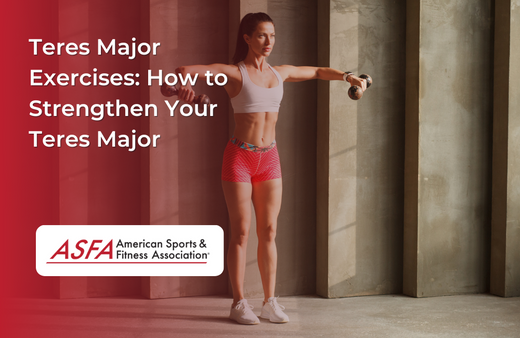
Teres Major Exercises: How to Strengthen Your Teres Major
A useful way to approach Teres Major Exercises: How to Strengthen Your Teres Major is to separate purpose, setup, execution, and progression.
Anatomy becomes useful when it explains movement, not when it is reduced to isolated muscle trivia. There is room for individual preference, provided the basic constraints are respected.
How to Apply It
For instructors: Anatomical descriptions explain likely roles, not perfect isolation. Muscle contribution changes with joint position, load, speed, fatigue, and individual structure.
Warm Up with Foam Rolling
Before you start your workout, it's important to warm up. Warming up increases blood flow to your muscles and joints, so they're ready for action.
To foam roll properly:
- Place the roller under one side of your body, then lie on top of it with most of your weight resting on the foam roller rather than on any other part of your body (e. G.
- Roll slowly back and forth over all areas where you feel tenderness or tightness--this could mean moving from just below one shoulder blade down toward another shoulder blade, or moving from one hip toward another hip, etc...
Foam Roll Your Teres Major Muscle and Rhomboids
You'll want to foam roll your teres major and rhomboids to strengthen your teres major muscles. The teres major is a shoulder muscle that helps rotate and extend the arm.
The rhomboids are muscles that run from the shoulder blade to the spine, pulling them together. Foam rolling these areas will help increase blood flow, reduce tightness in these small muscles, and improve posture by strengthening them so they can pull more effectively during movement.
Reverse Fly
The reverse fly is a great exercise for strengthening your teres major. The teres major muscle plays an important role in arm swinging movements and works to stabilize the lats during such movements.
To do this exercise:
- Lie on your stomach with a dumbbell in each hand and palms facing inwards towards each other.
- Raise both arms to shoulder height while keeping elbows bent at 90 degrees (or as close as possible).
- Lower them slowly until they’re just above the floor before repeating for reps if desired.
Dumbbell Fly
To perform the dumbbell fly:
- Lay down on your back with your knees bent and feet flat on the floor.
- Hold a dumbbell in each hand at arm's length in front of your body, with arms extended above your chest, palms facing inward towards each other.
- Slowly lower both weights until they’re just above your upper abs, then raise them again to complete one rep.
The teres major muscles are primarily used during this exercise because they help lift and rotate your shoulders when performing it correctly–they also assist with bending at the waist and rotating at the hips if needed for balance purposes (like when doing squats ). By strengthening these muscles through exercises like this, you’ll be able to lift heavier weights over time without getting sore or injured as often during workouts!
Cable Fly
To do this exercise, you’ll need a cable machine. Stand before the machine and grab the handles with your palms facing forward.
If this isn’t possible on a cable machine due to lack of equipment or space limitations, try doing dumbbell flies instead by holding two dumbbells at arm’s length before you and slowly lowering them toward each other until they touch before raising back up again.
Lateral Raise
The lateral raise is one of the best exercises to strengthen your teres major muscles. The teres minor plays an important role in supporting lateral or external rotation of the arm at the shoulder joint.
- Stand with feet hip-width apart and hold a dumbbell in each hand, palms facing inward (toward each other).
- Lift arms until they are at shoulder height with elbows bent 90 degrees and upper arms parallel to the floor.
- Lower slowly until arms hang at sides again.
- Repeat ten times for two sets on each side, three times per week for best results!
Chest Press for Shoulder Joint Stability
- Lie on your back and place your feet flat on the floor.
- Extend both arms straight out in front of you, palms facing down.
- The chest press exercise also engages the triceps brachii, which works alongside the pectoral muscles.
- Lift the weights so they’re just above shoulder level with elbows locked out and upper arms parallel to the floor (the position of a “chest press “). Don’t arch or round your back as you lift the weight; keep it straight throughout this exercise!
Incline Fly
If you want to strengthen your teres major, try this exercise:
- Grab a light dumbbell or use the cable machine. Lie on an incline bench at about 30 degrees and hold the weight in front of your chest with both hands.
- Keep your elbows close to your sides as you raise the dumbbell toward the ceiling until it reaches shoulder level (or higher). Pause, then lower slowly back down to starting position.
Exercise Tips for Rotator Cuff Muscles
When performing these exercises, it is important to control the teres major muscles. The teres major plays an important role in moving the arms and shoulders, and strengthening this muscle is useful to prevent potential shoulder pain.
Always warm up before any strenuous activity and stretch afterward to help manage injury risk.
Rest days are important for recovery, so don’t overdo it!
When to Modify or Stop
Exercise should be adjusted for the participant's experience, symptoms, environment, and available supervision. Stop for sharp pain, dizziness, chest discomfort, sudden weakness, or loss of control, and seek appropriate professional guidance when symptoms are persistent or concerning.
Next-Step Perspective
Keep the goal visible, make the smallest change that addresses it, and reassess before adding complexity.
Turn the Information Into a Decision
The structures discussed in Teres Major Exercises: How to Strengthen Your Teres Major do not work in isolation; their contribution changes with leverage, direction, speed, and the task being performed.
Identify the movement to be trained before deciding which muscle deserves emphasis. Joint position, grip, stance, range, external load, and speed can change the contribution of several structures at once. The same anatomy may therefore be challenged differently across exercises that look similar on paper.
Keep the Recommendation Proportional
Anatomy describes possible functions, not a single mandatory technique. A controlled movement can look somewhat different across individuals while still meeting the same objective. The useful standard is whether the setup is stable, the range is appropriate, and the intended task can be repeated without compensation that changes the exercise.
What Not to Assume
- Forcing an exercise to look identical for every participant.
- Increasing resistance before the movement is repeatable.
- Confusing a muscle’s possible action with the best training choice for a specific person.
- Ignoring how joint angle and leverage change the task.
The goal is not perfect control of every variable. It is enough consistency to make an informed next decision.


