
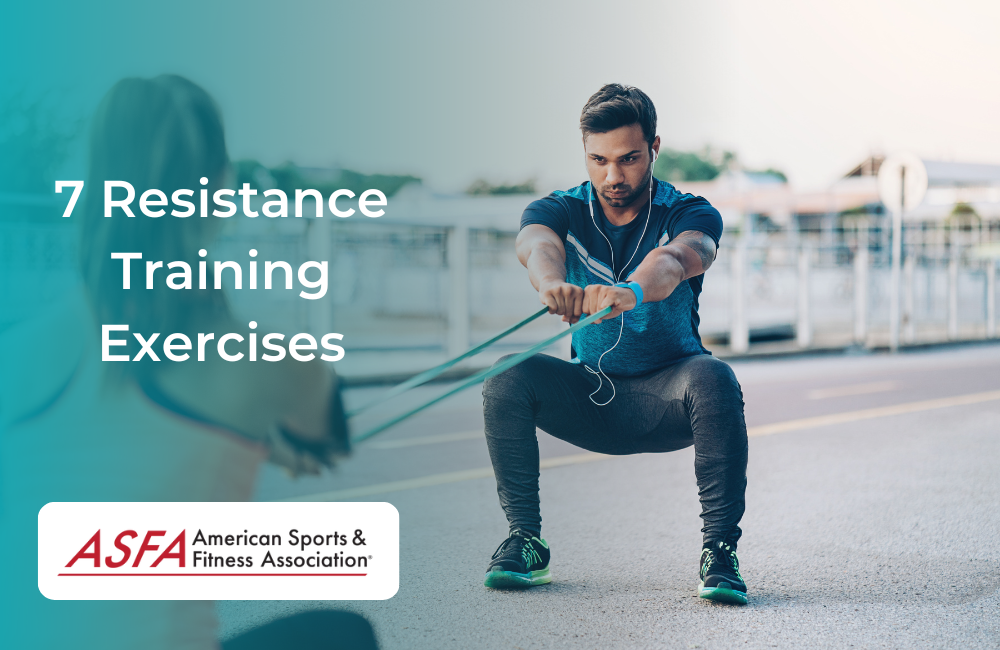
7 Resistance Training Exercises
Resistance training uses external load, body weight, bands, machines, or other forms of resistance to challenge the muscles. A balanced program includes pushing, pulling, squatting, hinging, single-leg, carrying, and trunk exercises in combinations that fit the person's goals and experience.
Seven Foundational Resistance Exercises
1. Squat
Use a bodyweight, goblet, front, or back-squat variation. Keep the feet planted and let the knees and hips bend together through a range you can control.
2. Romanian Deadlift
Hold dumbbells or a barbell close to the legs, push the hips backward, and return to standing by extending the hips. This hinge pattern trains the hamstrings, glutes, and trunk.
3. Push-Up
Place the hands on the floor or an elevated surface, keep the body organized from head to heels or knees, and lower the chest between the hands. Press back to the starting position without letting the hips sag.
4. Row
Use a cable, dumbbell, resistance band, or suspension trainer. Pull the handle toward the torso while controlling the shoulder blade, then return without letting the weight jerk the arm forward.
5. Overhead Press
Press dumbbells or a bar overhead while keeping the ribs and pelvis controlled. Use a landmine press or another pain-free angle when full overhead motion is not comfortable.
6. Split Squat
Use a staggered stance, lower both knees under control, and drive through the front foot to stand. The split squat trains each leg independently and can be adjusted with stance length and support.
7. Farmer Carry
Hold weights at the sides and walk with steady posture and breathing. Carries train grip, trunk stability, and whole-body control.
How to Build a Session
Choose four to six movements that cover the major patterns. Beginners can start with one to three sets per exercise and a load that permits consistent technique. Add repetitions or a small amount of resistance as the movements become easier. Rest long enough to repeat the next set with control.
Resistance training expends energy and helps build or maintain muscle, but it does not guarantee fat loss or keep metabolism elevated by a fixed amount. Body-composition change depends on the full pattern of training, activity, nutrition, and recovery.
Safety and Progression
- Warm up with lighter versions of the planned exercises.
- Use stable equipment and appropriate safety supports.
- Stop a set when technique changes substantially.
- Increase one training variable at a time.
- Modify or replace exercises that cause sharp pain.
ASFA's Personal Trainer Certification covers foundational program design for fitness professionals.
Practical Takeaway
A useful resistance program is built around repeatable movement patterns and gradual progression. Exercise selection should fit the person rather than forcing every lifter into the same seven movements.
Turning Seven Exercises into a Program
A useful resistance session does not require all seven movements every time. Select one squat or single-leg pattern, one hinge, one push, one pull, and one trunk or carry exercise. Add a second movement only when it serves a clear goal and recovery supports it.
Beginner Full-Body Example
- Goblet squat: three sets of eight to twelve.
- Dumbbell Romanian deadlift: three sets of eight to twelve.
- Elevated push-up: three controlled sets.
- Resistance-band row: three sets of ten to fifteen.
- Suitcase carry: three walks per side.
Train two or three nonconsecutive days per week. Keep several repetitions in reserve while learning technique and increase load in small steps.
Progressive Overload Without Guesswork
Choose a repetition range. When all sets reach the top of the range with consistent form, increase the resistance slightly and return to the lower end. This simple double-progression method creates a clear reason for each change.
What Resistance Training Does Not Require
- Training every set to failure.
- Changing exercises every week.
- Being sore after every session.
- Using only barbells or machines.
- Copying the program of a more advanced lifter.
Recovery and Technique
Allow enough time between sessions for performance to recover. Sleep, food intake, other sports, and job demands all affect readiness. Stop or modify an exercise that produces sharp pain or persistent symptoms; fitness programming is not a substitute for evaluation of an injury.
How Hard Should a Set Be?
Most working sets do not need to reach absolute failure. Beginners benefit from stopping with several good repetitions available while they learn. More experienced trainees may work closer to failure on stable accessory exercises and keep more reserve on technical compound lifts.
Use the same technique standard across sets. If the repetition only “counts” because range shortens, momentum increases, or a spotter lifts the load, it does not represent the same exercise for progression purposes.


