
7 Killer Abs Exercises for 6-Pack Abs
7 Killer Abs Exercises for 6-Pack Abs is most useful when each item connects to a real training or coaching decision. A longer list is not automatically a better one.
Core training is about controlling the trunk while the limbs move or external forces change. More fatigue is not automatically better control. The practical question is how to use the information without overstating it.
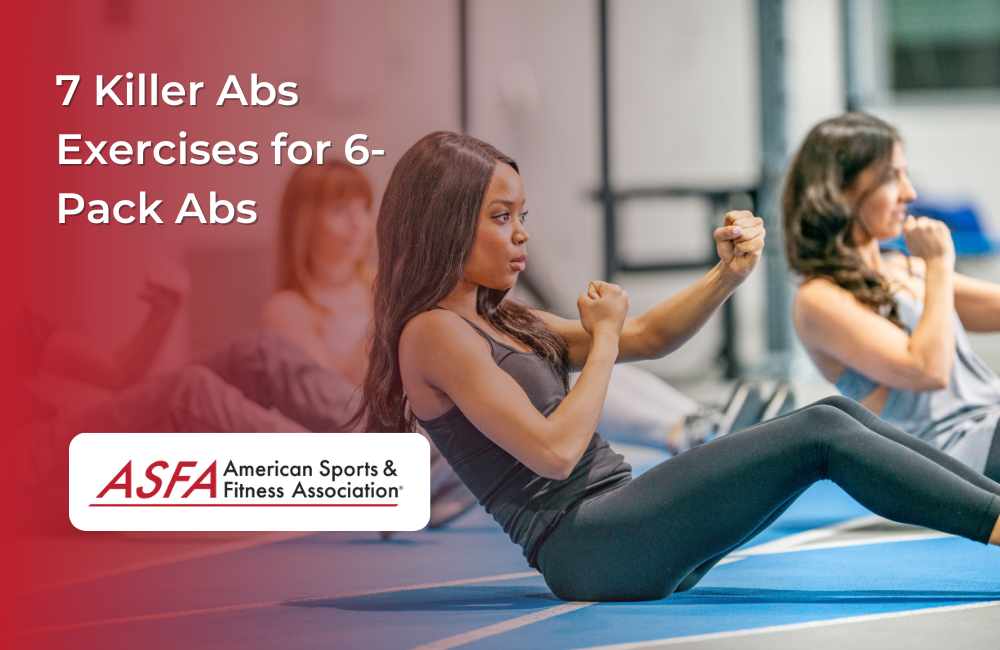
1) Seated Russian Twist
The seated Russian twist is an effective exercise that targets the muscles of your core, including your obliques and transverse abdominus. It's a great exercise to help you build strength and tone your midsection, while also helping to improve your balance and stability.
To perform the seated Russian twist, begin by sitting on the floor with your knees bent, feet flat on the floor, and your hands clasped together in front of your chest. Keep your chest lifted and engage your core.
2) Pilates Scissor
The Pilates Scissor is a great exercise for toning the core and strengthening the abdominal muscles. This exercise can be done either lying on your back or standing.
To begin, start by lying on your back with your legs in a tabletop position (bent knees, feet off the ground). Place your hands palms down beside your torso.
Repeat this scissor motion 15-20 times or for 60 seconds. Remember to keep your abs engaged throughout the entire movement to maximize the effect of the exercise.
3) Reverse Crunch
The reverse crunch is an incredibly effective ab exercise that targets your lower abs. It's one of the best exercises for strengthening and sculpting the lower abdominal muscles.
To begin, lie on your back on the floor with your hands behind your head and your legs extended. Then, using your core muscles, lift your legs off the floor and curl them in towards your chest.
Once your knees are as close to your chest as you can get them, hold this position for a few seconds. After that, slowly and with control, lower your legs back down to the floor.
4) Leg Lifts
To do a leg lift, start by lying on your back with your legs straight and together. Lift both of your legs up towards the ceiling and then slowly lower them back down until they just about touch the floor.
Make sure that your lower back is pressed firmly into the floor throughout the exercise. As you lift and lower your legs, focus on engaging your core muscles and keeping your legs as straight as possible.
5) Double Crunch
The double crunch is a great exercise for strengthening your abdominal muscles and getting a rock hard six-pack. To perform the exercise, start by lying flat on your back with your knees bent and feet flat on the floor.
This exercise can be done for reps or for time (e. G.
6) Stability Ball Pike
The Stability Ball Pike is an excellent exercise for targeting your abs and strengthening your core. To do this exercise, start by sitting on the Stability ball with your feet flat on the floor and your hands behind your head.
7) Side Plank
The side plank is a great core exercise that targets the muscles of your midsection and provides stability to your spine. It is a more advanced exercise and should only be done if you have a strong core.
A Clear Bottom Line
Treat the method as a tool, not an identity. Keep what improves the plan and remove what does not.
Use It in Practice
Programming note: Core exercises should match the position the participant can control. Increase lever length, load, or movement one variable at a time rather than using discomfort as a progress marker.
What Changes the Answer
With 7 Killer Abs Exercises for 6-Pack Abs, the same recommendation can produce different results for two people. Experience, recent workload, movement skill, available equipment, schedule, preferences, and recovery all change what is reasonable.
Review the result over several exposures rather than judging one unusually good or difficult session. Useful progress is usually visible as better control, a more appropriate workload, improved consistency, or clearer decision-making.
Give the Idea a Clear Job
The useful question is not whether 7 Killer Abs Exercises for 6-Pack Abs belongs in every routine, but what job it should perform in a specific program.
Decide whether the priority is skill, strength, muscle development, mobility, work capacity, or general activity. That choice affects exercise order, range of motion, resistance, repetitions, rest, and frequency. A program becomes harder to evaluate when several goals are pursued in the same set without a clear priority.
Put the Guidance Through This Test
- Which variation allows the intended technique today?
- What load, range, tempo, and rest will be recorded?
- What sign will indicate that the set or session should stop?
- Which single variable may progress next?
- How will this work fit with the rest of the week?
- What is the primary training objective?
If those questions have clear answers, the guidance is more likely to produce a plan that can be followed and evaluated.
Adjust One Variable at a Time
Small programming changes can make the same movement serve a different purpose. Slower repetitions increase time under tension; longer rest may preserve force; shorter rest changes the conditioning demand; additional range can increase difficulty even without more weight.
- Choose the variable that best matches the current goal.
- Record enough detail to repeat the session accurately.
- Do not treat fatigue as proof that the exercise was well selected.
- Progress only while the intended movement pattern remains recognizable.
Build a Progression You Can Defend
Start with a version that allows a stable setup and repeatable range. Establish a baseline for repetitions, load, tempo, and perceived effort. Progress one element—such as another repetition, a small resistance increase, more range, or a more demanding variation—only when the prior version remains controlled. If technique changes early, recovery declines, or the target area is no longer doing the intended work, reduce the demand and rebuild from a clearer baseline.
Create a Useful Feedback Loop
A short record is usually enough. Review:
- recovery, soreness, and performance in the next session
- repetitions completed with the intended technique
- load, range, tempo, and rest used
- perceived effort and how close the set came to technical failure
Keep the review connected to the original goal. More information is not automatically better when the important result remains unclear.
Use Principles Without Forcing Uniformity
Two people can use the same exercise for different reasons and need different versions. Training history, limb proportions, mobility, confidence, equipment, schedule, symptoms, and the rest of the program all affect the decision. Standardize the objective and the tracking method; individualize the setup and dose. That balance makes comparisons more useful without forcing every repetition to look identical.


