
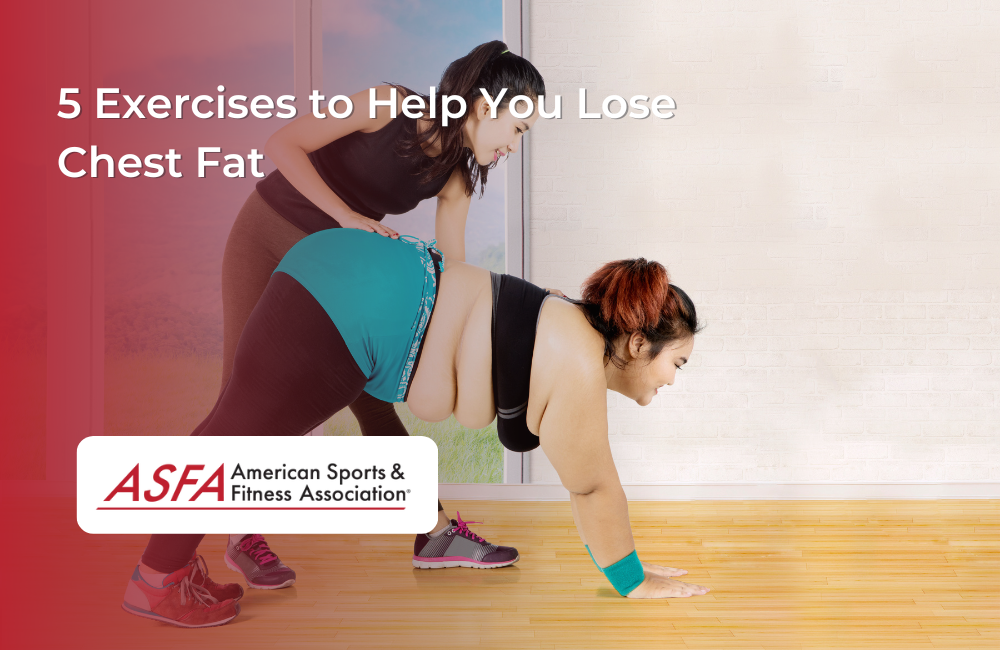
5 Exercises to Help You Lose Chest Fat
The points in 5 Exercises to Help You Lose Chest Fat are organized around practical application rather than exaggerated promises.
Technique is not a single perfect shape. It is a repeatable way to complete the movement while controlling the load, range, and positions that matter for the goal. That is where the details become useful.
Before You Progress
Keep in mind: Choose the variation that permits a stable setup and repeatable range. Add repetitions or resistance only while the same control is maintained; stop when pain or compensation changes the movement.
Exercise 2: Incline Push-Ups
Incline push-ups are a variation of the standard push-up that targets the upper chest muscles more intensely. This exercise is effective for building chest strength and reducing fat.
How to Perform Incline Push-Ups:
- Find a sturdy surface like a bench, chair, or step.
- Place your hands on the surface, shoulder-width apart, and extend your legs behind you so that your body forms a straight line from head to heels.
- Lower your chest towards the surface, keeping your elbows close to your body.
- Push back up to the starting position, fully extending your arms.
Exercise 4: Pushups
Pushups are a great exercise for losing chest fat and can help you lose weight by burning calories and building muscle. Pushups work your chest, shoulders, and triceps muscles.
Tips for Pushups:
- Modify for Beginners: Start with hands on a chair or against a wall if needed.
- Increase Difficulty: Add more reps or lower yourself further into each repetition for increased difficulty.
- Consistency: Perform pushups regularly to see significant improvements.
Day 2: Rest or Light Activity
- Gentle yoga or stretching
- Light walking
Day 3: Upper Body Strength
- Dips: 3 sets of 12 reps
- Pushups: 3 sets of 15 reps
- Plank to Pushup Transition: 3 sets of 10 reps
- 20 minutes of cycling or stationary bike
Day 7: Active Rest
- Light activity such as walking or gentle yoga
Nutrition and Calorie Deficit
To effectively lose chest fat, it's essential to combine your exercise routine with a healthy diet that creates a caloric deficit. This means consuming fewer calories than you burn each day.
- Balanced Diet: Focus on a diet rich in fruits, vegetables, lean proteins, and whole grains.
- Hydration: Drink plenty of water to stay hydrated and help control hunger.
- Avoid Unhealthy Foods: Limit your intake of fried foods, sugary snacks, and high-calorie beverages.
- Portion Control: Be mindful of portion sizes to avoid overeating.
A Necessary Safety Note
Exercise should be adjusted for the participant's experience, symptoms, environment, and available supervision. Stop for sharp pain, dizziness, chest discomfort, sudden weakness, or loss of control, and seek appropriate professional guidance when symptoms are persistent or concerning.
Where This Leaves the Decision
Good coaching leaves room for feedback. If the response does not match the goal, adjust the dose, range, exercise, or expectation.

Make the Decision Specific
Before applying 5 Exercises to Help You Lose Chest Fat, define the outcome in terms that can be observed. That may be steadier technique, a tolerable training dose, better consistency, clearer client communication, or a decision between two reasonable options.
- Goal: State what should improve and why it matters.
- Starting point: Use the person's current ability, experience, equipment, and constraints.
- Dose: Decide how much work or change is appropriate before adding more.
- Feedback: Track technique, tolerance, consistency, and the response after the session.
Keep the Feedback Loop Short
Keep the first adjustment modest. If the response is useful and repeatable, progress one variable—such as range, load, duration, complexity, or frequency. If the result is poor, change the limiting variable instead of assuming that more effort will solve it.
A More Useful Standard
With 5 Exercises to Help You Lose Chest Fat, the same recommendation can produce different results for two people. Experience, recent workload, movement skill, available equipment, schedule, preferences, and recovery all change what is reasonable.
Review the result over several exposures rather than judging one unusually good or difficult session. Useful progress is usually visible as better control, a more appropriate workload, improved consistency, or clearer decision-making.
Turn the Information Into a Decision
The guidance in 5 Exercises to Help You Lose Chest Fat is most useful when it is placed inside the person’s complete eating pattern rather than treated as a rule about one food or nutrient.
Clarify whether the goal involves meal convenience, performance fueling, recovery, body-composition planning, or general dietary variety. Then examine the complete meal and the rest of the day. The same item can play a different role depending on portion size, timing, preparation, and what accompanies it.
Context Changes the Best Choice
The same food can be useful in one meal and unnecessary in another. Context determines whether the portion and timing support the goal. Avoid moral labels such as “good” or “bad” when a more precise description—convenient, nutrient-dense, energy-dense, high in protein, low in fiber, or easy to tolerate—would support a better decision.
Avoid These Planning Errors
- Comparing labels that use different serving sizes.
- Using general education to manage a condition that requires individualized guidance.
- Following a trend that conflicts with preferences, budget, access, or tolerance.
- Treating supplement marketing as a substitute for a workable eating pattern.
The goal is not perfect control of every variable. It is enough consistency to make an informed next decision.
A Practical Review Checklist
- Is the plan realistic for schedule, budget, access, and preferences?
- What response will be monitored across normal days?
- Is individualized guidance needed for a condition, allergy, or complex goal?
- What is the smallest sustainable improvement?
- What is the actual portion and preparation method?
- How does the choice fit the complete meal and day?
The checklist is intentionally practical: each answer should change how the plan is designed, delivered, or reviewed.
Adjust One Variable at a Time
Nutrition choices are easier to evaluate when the variables are visible. A food eaten alone may produce a different experience than the same food combined with protein, carbohydrate, fat, fiber, and fluid in a complete meal.
- Keep cultural preferences and budget inside the plan.
- Read the full label when packaged foods are involved.
- Account for preparation oils, sauces, and added ingredients.
- Use a realistic weekly pattern instead of an idealized single day.
Review Before You Add More
Change the plan in small, observable steps. That might mean adding one consistent meal, adjusting a portion, preparing a reliable snack, improving fluid access, or testing a different timing strategy. Review the change across several normal days rather than judging it from one workout or one meal. A workable improvement should fit the person’s schedule and remain tolerable enough to repeat.


