
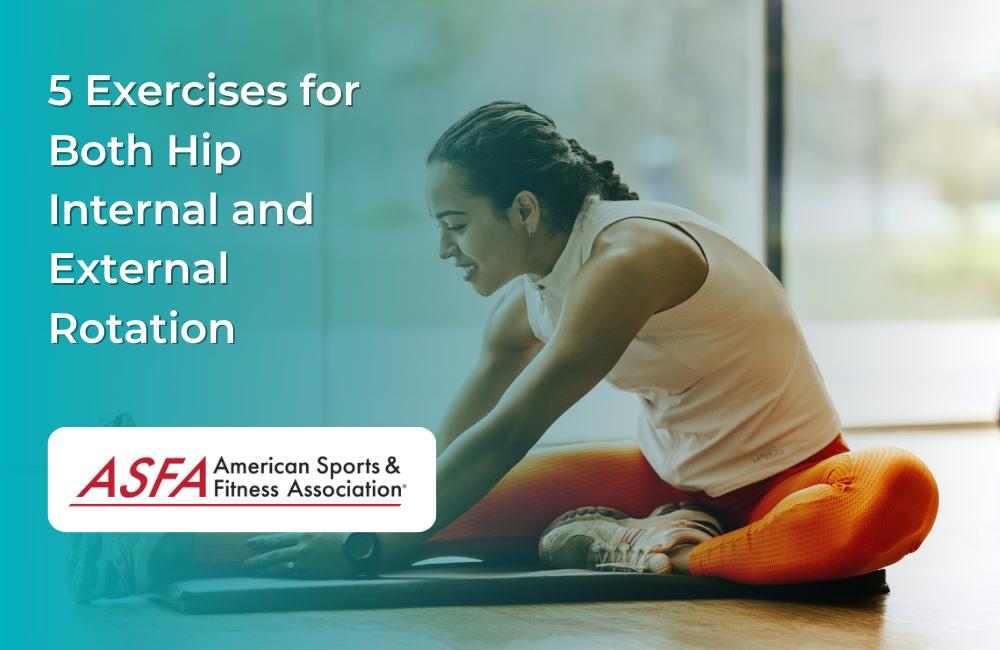
5 Exercises for Both Hip Internal and External Rotation
5 Exercises for Both Hip Internal and External Rotation covers several ideas, but they do not all carry the same weight. Start with the points that affect execution and consistency.
Technique is not a single perfect shape. It is a repeatable way to complete the movement while controlling the load, range, and positions that matter for the goal. That is where the details become useful.
A Necessary Safety Note
Exercise should be adjusted for the participant's experience, symptoms, environment, and available supervision. Stop for sharp pain, dizziness, chest discomfort, sudden weakness, or loss of control, and seek appropriate professional guidance when symptoms are persistent or concerning.
Understanding Hip Anatomy
The hip joint is a ball-and-socket joint, one of the most flexible joints in the human body. It connects the femur (thigh bone) to the pelvis, allowing for a broad mix of motion in multiple directions.
- Gluteus Medius and Gluteus Minimus: These muscles, located on the outer surface of the pelvis, are primarily responsible for hip abduction and internal rotation.
- Piriformis: A small muscle located deep in the buttock, which aids in hip external rotation.
- Adductors: Located on the inner thigh, these muscles assist in hip adduction and also play a role in internal rotation.
- Tensor Fasciae Latae (TFL): A muscle that helps with hip abduction, flexion, and internal rotation.
- Obturator Internus and Externus: These deep muscles are involved in hip external rotation.
1. 90/90 Hip Stretch
The 90/90 hip stretch is an excellent exercise to improve both hip internal and external rotation. Hip internal rotation, a useful movement pattern that involves the inward turning of the hip joint, helps increase flexibility and mobility in the hips, making it ideal for anyone looking to enhance their range of motion.
- Sit on the floor with your right leg bent at a 90-degree angle in front of you, forming an “L” shape with your knee and ankle.
- Place your left leg behind you, also bent at a 90-degree angle, creating another “L” shape.
- Your right knee should be pointing forward, and your left knee should be pointing to the side.
- Lean forward, keeping your chest over your right knee to deepen the stretch for internal rotation. Hold for 30 seconds to 1 minute.
- Lean back, keeping your chest over your left knee to stretch for external rotation. Hold for 30 seconds to 1 minute.
2. Hip Circles
Hip circles are a dynamic exercise that promotes both hip internal and external rotation, specifically targeting internal hip rotation to improve hip mobility and strength. They are also effective in warming up the hip joint and improving overall mobility.
- Stand with your feet hip-width apart.
- Place your hands on your hips for balance.
- Begin by circling your hips clockwise, focusing on both internal and external rotation as you move.
- Perform 10-15 circles in one direction, then switch to counterclockwise for another 10-15 circles.
- Make the circles as large as your mobility allows without causing discomfort.
3. Pigeon Pose
Pigeon pose is a popular yoga pose that targets the hips and provides a deep stretch for both internal and external rotation. The hip internal rotator muscles play an important role in facilitating normal hip internal rotation, contributing to the overall effectiveness of this stretch.
- Start in a plank position with your hands under your shoulders.
- Bring your right knee forward and place it behind your right wrist.
- Extend your left leg behind you, keeping it straight.
- Your right foot should be flexed, and your hips square to the front.
- Lower your chest toward the ground, keeping your spine straight, to deepen the stretch for external rotation.
4. Butterfly Stretch
The butterfly stretch is a classic exercise that primarily targets hip external rotation but also provides some benefits for internal rotation. Poor hip internal rotation can impact overall mobility and lead to compensatory movements in other joints, resulting in knee pain and lumbar spine issues.
- Sit on the floor with your feet together and your knees bent out to the sides.
- Hold your feet with your hands.
- Gently press your knees toward the floor, feeling the stretch in your hips.
- To focus on external rotation, gently push your knees down and hold for 30 seconds to 1 minute.
- To focus on internal rotation, pull your feet closer to your body while keeping your knees bent and hold for 30 seconds to 1 minute.
5. Hip Internal and External Rotation with Resistance Band
This exercise uses a resistance band to provide resistance during hip internal and external rotation movements, helping to strengthen the hip muscles while improving mobility.
- Attach a resistance band to a sturdy anchor point or door frame at hip height.
- Stand sideways to the anchor point with the band around your outer thigh.
- For External Rotation: Step away from the anchor point with your inner leg while keeping the band around your outer thigh. Stand with feet hip-width apart.
- Hold onto a stable support for balance if needed.
- Keeping your knee stationary, push your outer thigh outward against the resistance of the band. Perform 10-15 reps.
Tips for Safe and Effective Hip Rotation Exercises
- Start Gently: Begin with gentle, controlled movements and gradually increase the range of motion as your flexibility improves.
- Listen to Your Body: Avoid any exercises that cause pain or discomfort, and always perform movements within your comfort zone.
- Consistency is Key: Perform these exercises regularly to maintain and improve hip mobility.
- Combine with Other Exercises: Incorporate these exercises into a comprehensive stretching and mobility routine to address other areas of the hip and lower body.
Sample Weekly Hip Rotation Workout Plan
Here’s a sample weekly workout plan to improve both hip internal and external rotation:
Day 1: Hip Flexibility and Mobility
- Warm-Up: 5-10 minutes of light cardio (e. G.
- 90/90 Hip Stretch: 3 sets of 30 seconds to 1 minute per side
- Hip Circles: 3 sets of 10-15 circles in each direction
- Cool-Down: 5-10 minutes of stretching focusing on the hips and lower back.
Day 2: Active Recovery
- Option 1: Light cardio (e. G.
- Option 2: Yoga session focusing on hip and lower body flexibility.
Before You Progress
Coach's note: Choose the variation that permits a stable setup and repeatable range. Add repetitions or resistance only while the same control is maintained; stop when pain or compensation changes the movement.
Where This Leaves the Decision
A sound plan does not need to look dramatic. It needs to be understandable, repeatable, and appropriate for the person using it.


