
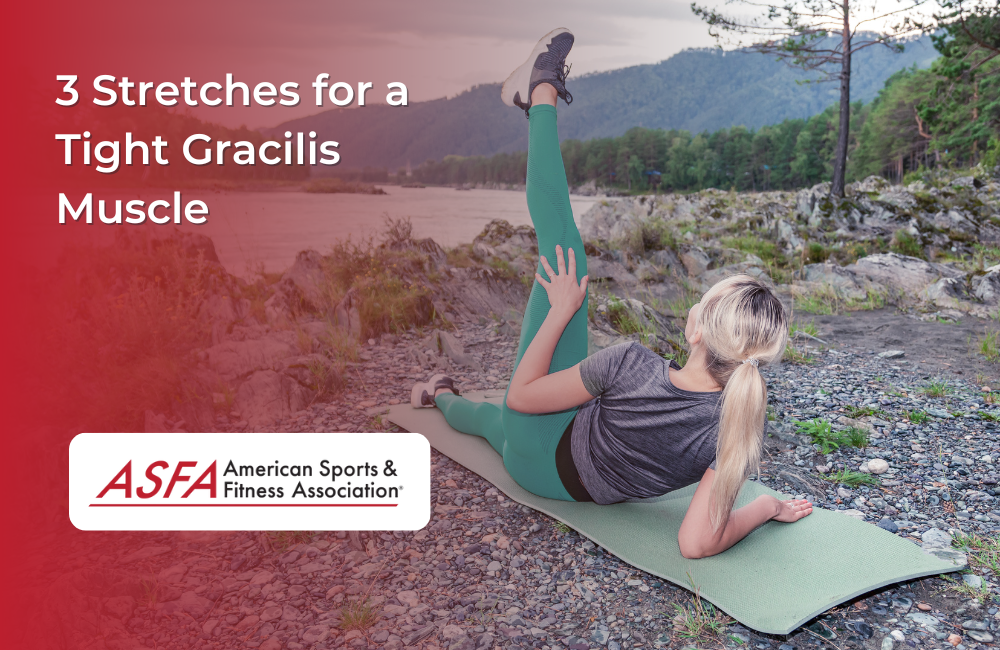
3 Stretches for a Tight Gracilis Muscle
3 Stretches for a Tight Gracilis Muscle covers several ideas, but they do not all carry the same weight. Start with the points that affect execution and consistency.
Mobility changes slowly and responds to regular practice. Sensation alone is not proof that a drill is helping. The next sections turn that principle into specific decisions.
Limits and Safety
Exercise should be adjusted for the participant's experience, symptoms, environment, and available supervision. Stop for sharp pain, dizziness, chest discomfort, sudden weakness, or loss of control, and seek appropriate professional guidance when symptoms are persistent or concerning.
Programming Considerations
A useful checkpoint: Use a range that creates tension without sharp pain, numbness, or loss of control. Longer or deeper is not automatically better; progress should be based on repeatable motion and the demands of the activity.
The Gracilis Muscle
The Gracilis muscle is a muscle in your inner thigh that helps flex and adduct your leg. As a hip adductor, it plays an important role in the adductor muscle group, aiding in various lower body movements and sports activities.
The Gracilis originates at the anterior surface of the upper part of the femur (thigh bone), crosses over its lateral epicondyle (bump on top), and inserts into the medial condyle (rounded end) of the tibia (shinbone). This means this muscle can be tight if you sit with bent knees for long periods or sit with your legs crossed often.
Symptoms of Gracilis Muscle Pain
- Burning, cramping, or aching in the groin area and lower abdomen
- Knee pain and pain behind one or both knees when walking or running
- Pain deep inside one or both groins
Causes of Tight Inner Thigh Gracilis Muscle
- Overuse
- Poor flexibility
- Poor posture
How to Stretch and Exercise Your Gracilis Muscle
The gracilis muscle is located among the inner thigh muscles on the medial side of your thigh. It lies underneath your sartorius muscle and semitendinosus muscles, so it’s important to stretch these other muscles before you get started with gracilis muscle stretching to alleviate pain in the groin and thigh area.
To stretch your gracilis muscle:
- Stand upright, with one foot in front of the other. Ensure both feet are pointed straight ahead (or slightly turned out), and knees bent at 90 degrees, but do not lock them out!
- Place a towel around an ankle or foot–whichever feels better for you–and bring that leg up until it’s parallel to ground level (or as close as possible). Hold onto something sturdy if necessary; don’t let go until after 15 seconds!
Gracilis Stretch Techniques
- Standing Gracilis Stretch: Stand upright with one foot in front of the other. Ensure both feet are pointed straight ahead (or slightly turned out), and knees are bent at 90 degrees, but do not lock them out.
- Place a towel around an ankle or foot—whichever feels better for you—and bring that leg up until it’s parallel to the ground level (or as close as possible). Hold onto something sturdy if necessary.
- Hold for 15 seconds, then switch legs.
Standing Stretch for the Gracilis Muscle
To perform this stretch, stand with your feet about hip-width apart and clasp your hands behind your back. The gracilis muscle plays an important role in hip adduction, which involves bringing the legs together, stabilizing, and rotating the knee inward.
Hold this position for 30 seconds before switching legs and repeating on the other side.
Hold opposite leg in that position for 15 seconds, then lower your leg back to the starting position. Repeat this exercise 5 times on each side, ensuring that both legs stretch equally!
Side Lying Stretch for the Gracilis Muscle
Start by lying on your side with one leg bent and the other straight to target the inner thigh muscles, particularly the gracilis muscle.
Place a pillow between your knees to help support them as they bend.
Lift the top knee, keeping it bent at 90 degrees, and place a hand on it for support.
Gently pull back on either side of your hip until you feel a gentle stretch in the groin area (you’ll know when). Hold this position for 30 seconds or so before switching sides.
The Practical Takeaway
Use the information to make one clear adjustment, then judge the result from repeatable performance rather than novelty.
Use a Goal-First Framework
The structures discussed in 3 Stretches for a Tight Gracilis Muscle do not work in isolation; their contribution changes with leverage, direction, speed, and the task being performed.
Use anatomy to explain why a movement may feel or perform differently, not to infer a condition from one sensation. Structure is only one part of the decision. Technique, fatigue, training history, workload, and the participant’s response all help determine whether the current exercise is appropriate.
Review Before You Add More
Use anatomy to select a reasonable starting point, then let performance guide progression. The objective is not to isolate every structure perfectly; it is to create an appropriate movement demand that can be repeated and recovered from. Record the variation and setup so future changes are based on comparable work.
Use Simple Evidence, Not Guesswork
Before changing the plan again, compare:
- symptoms that persist or change in a concerning way
- the movement variation and joint position
- range, resistance, tempo, and technique consistency
- whether the intended task improves across comparable sessions
Keep the review connected to the original goal. More information is not automatically better when the important result remains unclear.
Adapt the Guidance to the Person
Anatomy describes possible functions, not a single mandatory technique. A controlled movement can look somewhat different across individuals while still meeting the same objective. The useful standard is whether the setup is stable, the range is appropriate, and the intended task can be repeated without compensation that changes the exercise.
Mistakes That Make the Result Harder to Read
- Increasing resistance before the movement is repeatable.
- Confusing a muscle’s possible action with the best training choice for a specific person.
- Ignoring how joint angle and leverage change the task.
- Forcing an exercise to look identical for every participant.
A clear plan does not remove uncertainty, but it makes the next adjustment more responsible and easier to explain.
Put the Guidance Through This Test
- Can the movement be performed with repeatable control?
- What variable will be progressed?
- Do persistent symptoms require appropriate evaluation?
- What movement or task is being examined?
- How do joint position and leverage change the demand?
The checklist is intentionally practical: each answer should change how the plan is designed, delivered, or reviewed.
The Details That Alter the Outcome
A muscle may act as a prime mover in one task, assist in another, and stabilize in a third. That is why one exercise cannot fully represent everything a structure does.
- Train movement patterns across appropriate ranges.
- Balance local muscle work with compound movement practice.
- Match resistance direction to the intended action.
- Use anatomy to improve cueing without promising a particular sensation.


